Soil testing
New research led by Dr Yassine Bouslihim at the National Institute of Agricultural Research (INRA) in Rabat suggests that soil colour analysis could transform how soil organic matter (SOM) is monitored in semi-arid agricultural systems.
Published in Carbon Research, the study demonstrates that digital colour indices can predict SOM with high accuracy while reducing analytical costs by 96% compared with traditional chemical methods.
For environmental and soil monitoring professionals, the significance lies not only in the technical performance, but in the economic feasibility. If validated at scale, colour-based analysis could lower the barrier to frequent, large-area carbon assessment.
Conventional SOM determination methods, such as Walkley–Black wet oxidation, require hazardous reagents, trained laboratory staff, and controlled chemical handling procedures. These workflows are labour-intensive and generate chemical waste.
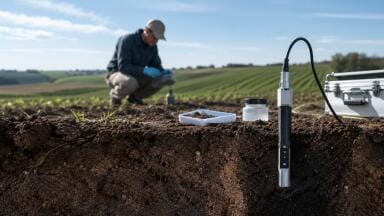
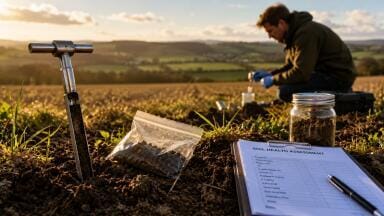
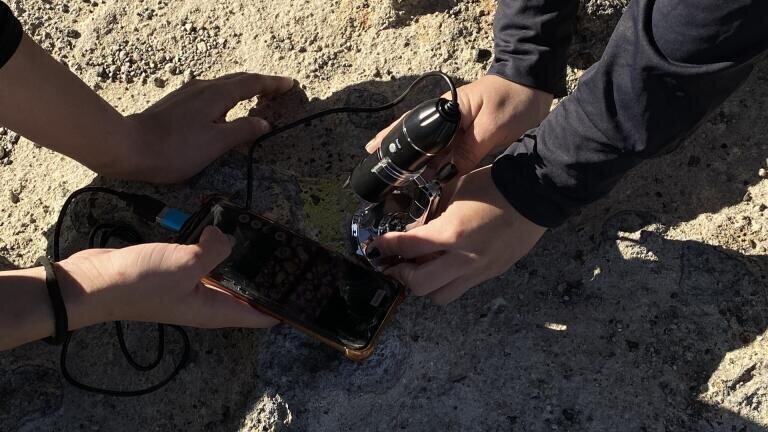
The Moroccan team evaluated whether digital colour analysis — effectively quantifying soil hue, saturation, and brightness — could act as a reliable proxy for organic matter content. Soil samples were analysed under both dry and moist conditions, and machine learning models were used to predict SOM from colour parameters.
The strongest performance came from Random Forest modelling applied to dry soil samples. Hue-based colour indices emerged as particularly powerful predictors, accounting for up to 47% of model explanatory power in moist soils.
The technical message is that soil reflectance characteristics, when quantified digitally, contain extractable information about carbon content.
The study moves beyond proof of concept to address economic viability. For a laboratory processing approximately 5,000 samples per year, digital colour analysis reduced costs by 96% relative to conventional chemical testing.
The capital investment in digital imaging or colour sensing equipment was projected to pay back within four months, with a five-year return on investment approaching 940%.
For monitoring laboratories operating under constrained budgets — particularly in semi-arid regions where routine soil carbon measurement is essential for land management — this shifts the discussion from technical possibility to operational practicality.
Semi-arid soils are highly sensitive to organic matter loss. Maintaining SOM is critical for water retention, structure stability, and crop resilience under climatic stress.
In many regions, however, high-frequency SOM testing is economically prohibitive. As a result, soil monitoring intervals are extended, limiting adaptive land management.
By reducing per-sample cost dramatically, digital colour analysis could enable more frequent sampling campaigns. This has implications for irrigation planning, fertiliser optimisation and soil restoration programmes.
Soil carbon is increasingly linked to climate mitigation frameworks and voluntary carbon markets.
Reliable, repeatable, and affordable measurement methods are essential if farmers are to participate in sequestration schemes.
Digital colour-based prediction is unlikely to replace laboratory-grade chemical analysis in regulatory or high-precision contexts.
However, it could function as a screening or baseline tool, identifying spatial variability and prioritising locations for confirmatory testing.
For large-scale carbon monitoring initiatives, particularly in developing regions, cost per data point is a limiting factor.
A 96% reduction materially alters feasibility at landscape scale.
For instrumentation professionals, the study highlights several technical priorities.
Calibration protocols must be robust across soil moisture conditions. Illumination consistency, sensor standardisation, and algorithm transparency are critical to reproducibility.
Machine learning integration is central.
The predictive power observed in the Moroccan trials depends on appropriate model training and validation under local soil conditions. Transferability to other soil types will require region-specific calibration datasets.
The broader implication is methodological. Soil monitoring may increasingly move from chemically intensive, laboratory-bound analysis toward digitally enabled, field-adaptable workflows.
Colour has long been recognised qualitatively as an indicator of soil fertility. This research quantifies that intuition and translates it into a measurable, economically viable monitoring framework.
If adopted widely, digital colour analysis could support higher sampling density, lower environmental footprint in laboratories, and expanded participation in soil carbon management programmes.
In semi-arid agricultural systems where margins are narrow and climate pressures are high, reducing the cost of soil intelligence may prove as important as improving its precision.
Read the full paper here.
IET Guide 2026

 Product directory