Soil testing
Published over 16 years ago. See the latest and most current information on Soil testing.
Soil is the loose covering of earth’s topmost surface, which is practically always active. Downwards the soil is bordered by solid or loose rocks. Towards the top it is mostly bordered by a cover of vegetation, as well as the atmosphere. Where the topmost layer of soil is covered by water, lakes, rivers and oceans it is considered sediment rather than soil. Depending on perceptions and scientific discipline “soil” can be defined differently.
In geology and in soil science the term soil is categorized according to DIN 4022 as follows:
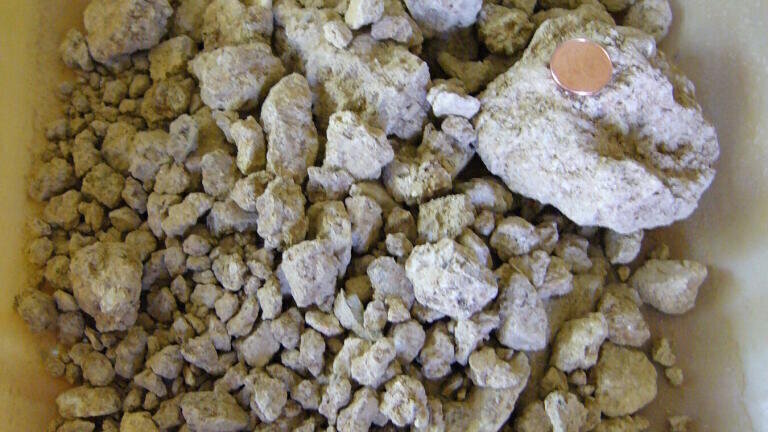
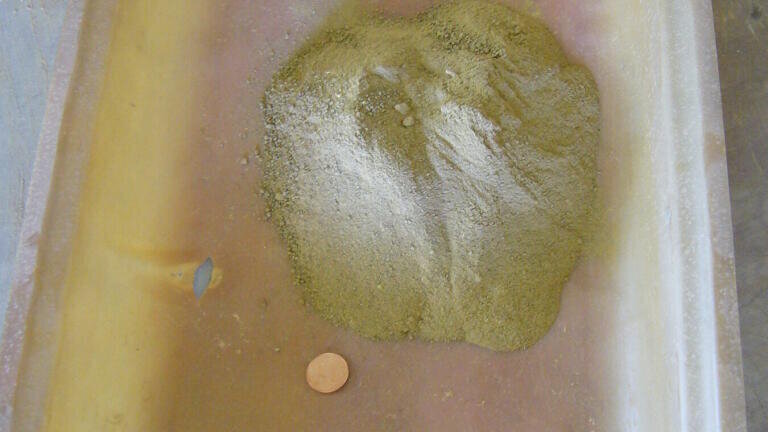
Scientifically it is proven, that all segments of gravel – the contents of the soil larger than 2 mm - are not available as nutrients for plants and also do not bond nutrients. It is also referred to as coarse soil. All soil contents with an equivalence diameter of 2 mm and smaller however, deliver nutrients for the plants themselves or bind nutrients for the plants, for example in the form of added fertilizer. This type of fraction is considered as fine soil.
For the preparation of agricultural soil samples for the analysis of nutrients, the VDLUFA demands in the book of methods Volume 1 “Analysis of soils” the separation of coarse and fine soil.
For examinations of radioactivity in the environment, the pre-treatment of the sample is described in DIN ISO 18589-2, radioactivity in the environment – soil part 2.
Also for examination of past polluted areas, the Federal Soil Protection and Past Contaminated Area Ordinance, assumes a separation at 2 mm.
This results in the following task: The sieving off and deagglomeration of soil samples of 2 mm.
During the preparation of soil samples, the shares of the coarse soil may not be comminuted, because then they would be considered as part of the fine soil, which would reveal a “dilution” of the contents of the fine soil. The results would be low analysis values of the nutrients and harmful substances - but still, agglomerates from fine contents have to be crushed in order to be driven through a 2 mm sieve.
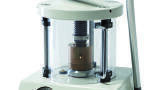
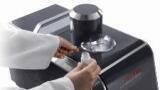
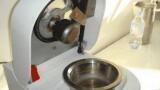
The conceptional design of the Soil Deagglomerator PULVERISETTE 8 from FRITSCH (Germany) guarantees with almost all soil samples, that for one, the agglomerates, which are almost rock hard, can be opened up and on the other hand that the coarse soil will not be comminuted. The rocks are collected in a separate collection vessel.
It may become problematic with highly binding soils or soils with a large share of rocks. Large rocks should be sorted out. High binding soils while damp should be spread out broadly and then air dried. Should, despite these measures not all agglomerates been crushed, in a few cases the samples have to be prepared or reworked. In the example a wooden hammer was used. In any case, it is to be ensured that no particles larger than 2 mm shall be comminuted and therefore distorting the sample.
IET 36.5 Sept/Oct 2026


 Product directory