Industrial emissions
Researchers at the University of Stuttgart and the Hefei Institutes of Physical Science have each developed compact, high-efficiency laser systems that bring laboratory-grade precision closer to field-ready, portable instrumentation.
Together, these developments signal a shift toward smaller, more reliable laser sources for atmospheric and industrial emissions monitoring.
At the University of Stuttgart, scientists from the 4th Physics Institute and Stuttgart Instruments GmbH have achieved a long-sought goal: a short-pulse laser system that is both highly efficient and small enough to fit in one hand.
Conventional femtosecond or picosecond systems are large, energy-intensive, and confined to laboratory use.
The new multipass optical parametric amplifier (OPA) overcomes those limits.
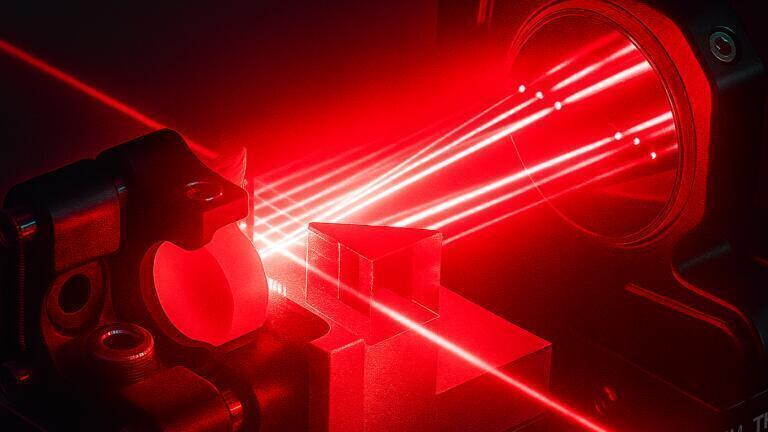
Instead of using one long nonlinear crystal, or many short ones connected in sequence, the system sends light through a single short crystal multiple times.
After each pass, the beam is realigned to stay synchronised with the pump pulse.
This design maintains amplification across a wide wavelength range while achieving efficiencies up to 80%, compared with about 35% in current systems.
For industrial emissions monitoring, that efficiency and compactness matter.
Tunable mid-infrared (MIR) lasers are central to spectroscopic gas analysis, as many air pollutants, including CO₂, CH₄, NOₓ, SO₂ and VOCs, absorb strongly in the MIR.
A portable, wavelength-flexible laser source could enable new types of field-deployable analysers, from compact open-path sensors and vehicle-mounted detectors to mobile calibration units for satellite instruments.
The Stuttgart system is part of the MIRESWEEP project, which focuses on low-cost, tunable MIR sources for analytical applications.
If commercialised, it could make infrared absorption spectroscopy more practical in industrial settings and environmental field campaigns, where continuous industrial emissions monitoring must balance precision with power use and ruggedness.
In parallel, researchers at the Hefei Institutes of Physical Science in China have re-engineered the excimer laser, a key deep-ultraviolet (DUV) source widely used in atmospheric and photochemical studies.
Traditional excimer systems rely on mechanical gas pumps to circulate the laser medium, generating noise and mechanical wear.
These drawbacks have restricted their use in portable or airborne monitoring equipment.
The Hefei team replaced mechanical pumping with a multi-needle electrohydrodynamic (EHD) pump, which drives gas flow using corona discharge rather than moving parts.
The resulting system, about the size of a thermos (Ø130 mm × 300 mm), achieved more than 2 mJ per pulse at 100 Hz with exceptional stability (1% energy variation).
A non-invasive schlieren velocimetry technique confirmed steady gas circulation through the laser cavity, essential for maintaining beam consistency.
The smaller, quieter design is directly relevant to field-based UV monitoring.
Deep-UV lasers are used to detect and study ozone, aerosols, and organic pollutants through absorption and fluorescence spectroscopy.
By eliminating mechanical components, the Hefei system makes UV sources suitable for deployment on drones, ships, or stationary remote-sensing platforms, supporting in-situ air quality and photochemical monitoring.
The research team also applied machine learning to model and predict pulse-energy transitions under different operating parameters.
This data-driven control allows adaptive optimisation of output stability, improving reliability in autonomous or long-term monitoring scenarios where environmental conditions vary.
Both the Stuttgart and Hefei designs address the same bottleneck: the trade-off between optical performance and deployability.
Environmental and industrial monitoring increasingly depend on laser-based spectroscopy for its selectivity, sensitivity, and fast response times.
But these systems have often been too large or delicate for continuous use in harsh field conditions.
Compact, high-efficiency sources could expand the reach of several key monitoring technologies: tunable infrared spectroscopy, UV absorption and fluorescence, laser-induced breakdown spectroscopy (LIBS), LIDAR, cavity-enhanced spectroscopy and photoacoustic detection.
Smaller, vibration-free lasers would make it easier to deploy multi-sensor units near industrial sites or urban pollution hotspots, reducing reliance on laboratory calibration.
The integration of AI-assisted control also supports self-calibrating, networked sensors that can maintain accuracy without manual adjustment, which is a growing priority in distributed air quality networks.
The engineering concepts behind both systems - multipass amplification and electrohydrodynamic pumping, respectively - share a common objective: replacing mechanical or spatial complexity with optical and electronic precision.
By minimising moving parts and energy losses, these designs lower maintenance demands and extend operational lifetimes.
For industrial emissions monitoring, where long-term stability and minimal downtime are essential, such features could lower cost of ownership and enable wider deployment.
In the longer term, compact laser modules could be integrated directly into automated sampling systems, mobile laboratories, or satellite ground-support stations.
Their tunability across infrared and ultraviolet wavelengths makes them adaptable to changing regulatory priorities, whether detecting methane leaks or quantifying nitrogen oxides.
The breakthroughs from Stuttgart and Hefei demonstrate that optical performance and portability can now coexist.
Both systems reduce energy consumption and mechanical complexity while improving control and precision.
If scaled into commercial products, they could accelerate the shift toward distributed, high-resolution industrial emissions monitoring networks capable of operating autonomously across diverse environments.
IET 36.5 Sept/Oct 2026


 Product directory




.jpg)














.jpg)




.jpg)