Air quality monitoring
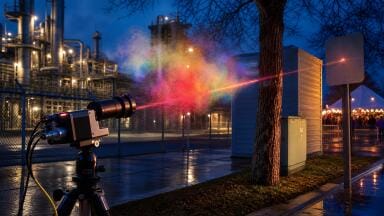
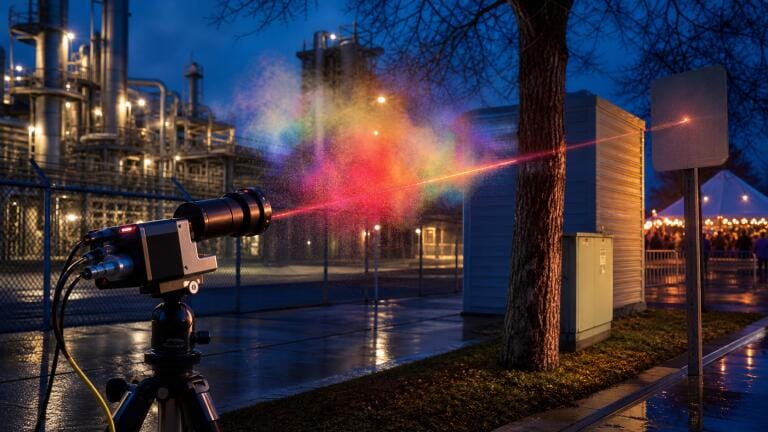
Researchers have developed and tested an infrared spectroscopy system that can rapidly detect chemical aerosols from a distance using light reflected from common surfaces, including traffic signs, tree trunks and painted surfaces.
The novel method could make it possible to detect hazards without complex instrumentation, and it could help to improve safety and ease operations at industrial sites, public venues and other high-risk locations.
‘Previously, many remote chemical detection systems have relied on placing a mirror or other highly reflective target in the field to bounce the laser signal back to the detector, which isn't practical in many real-world situations,' said Dr Tim Johnson, research team leader at Pacific Northwest National Laboratory (PNNL), Richland, Washington.
‘Our approach eliminates that requirement by using reflections from ordinary surfaces, allowing us to detect aerosolised chemicals from a distance without installing specialised equipment at the target location,' he said.

The researchers have reported results from laboratory tests that used reflected infrared laser light from a range of surfaces.
The tests showed that many non-metallic surfaces could be used for aerosol and vapour detection at standoff distances of up to 11 metres.
‘The ability to detect aerosols or vapours from tens of metres away without complex equipment could improve safety in a wide range of settings, from protecting workers and military personnel to detecting chemical spills and monitoring facility perimeters,' said Johnson.
‘For example, it could be used at large sporting events or concerts to help identify an accidental or intentional chemical release before it reaches the crowd,' he added.
When hazardous chemicals are released into the environment, they often exist as aerosols, as tiny liquid droplets, or could also include solid particles, suspended in the air.
Although infrared spectroscopy can be used to identify the chemical composition of aerosols, this analytical technique has proved difficult to implement outside the laboratory.
One of the biggest obstacles to the use of infrared spectroscopy in the field has been reliance on mirrors to reflect light back to the instrument to enable detection.
Even where it is possible to position a mirror, it is difficult to maintain stable optical alignment, and mirror surfaces can quickly become scratched or dirty, degrading instrument performance.
The researchers have developed a method that removes the need for such mirrors, so that the laser can instead be directed at everyday surfaces.
The reduced reflectivity of these surfaces is offset in part by the use of high-power lasers and software designed to parse noise in the data, in order to detect the reflected light at the detection system.
Another key advance was an infrared laser and telescope system that automatically adjusts the outgoing laser beam for different standoff distances, while efficiently collecting the returning light, to maximise the amount of signal that reaches the detector.
‘Even if they aren't 100 per cent reflective like a new mirror, many surfaces offer substantial reflectivity,' said Johnson.
‘Our approach makes it possible to use these surfaces to generate enough optical signal for the spectrometer to detect an aerosol chemical plume in the path of the laser beam,' he said.
As part of the work, the researchers have characterised the reflectivity of almost 50 common materials, including siding (cladding for buildings), wallboard, traffic signs, tree bark and car panels.
To evaluate the novel method, the researchers constructed an aerosol chamber in which they could generate aerosols with well-characterised particle sizes and chemical compositions, including chemical mixtures.
They used the chamber to test the method with a subset of the reflective surfaces they had previously characterised, analysing several different aerosols, including diethyl sebacate, used as a stand-in for hazardous chemicals, and calcium carbonate, which is found in rocks such as chalk and limestone.
In each case, the system detected and identified the aerosols despite differences in chemical composition and surface reflectivity.

The researchers next intend to evaluate the method with aerosols that have broader distributions of particle size and increasingly complex chemical mixtures.
These more realistic scenarios produce more complex infrared spectra, which makes chemical identification more challenging.
The team expects that artificial intelligence and machine learning could help to analyse more complex spectral signatures and hence improve detection performance.
For further reading please visit: 10.1364/AO.604722
IET 36.5 Sept/Oct 2026




 Product directory