Air quality monitoring
The UK’s new housing secretary, Steve Reed, has vowed to “build baby build” with a promise to build 1.5 million homes.
He even gave away free Maga-style baseball caps featuring the three-word motif.
This will be achieved, he says, “Through major planning reform and investment.” Adding: “We will break down the barriers to development.”
The major concern, therefore, is that one of these barriers will be environmental protection.
More housing creates more nutrient pollution in rivers and groundwater. But the focus of this column will be the impact of development (not just housing) on air quality.
Here, the real danger is that the planning system is already skewed in favour of development. Developers can easily generate models that indicate “no significant harm” to air quality.
The problem with air quality models is that they predict a post-development value for a pollutant, often with 1 or even 0.1 µg/m3 resolution. That's despite the fact that the inputs to the models are riddled with high levels of uncertainty.
Air Quality Assessments (AQAs) are necessary for proposals that represent a potentially significant threat to air quality.
They therefore form part of development proposals for large projects, for certain industrial processes and where there are sensitive receptors or an existing Air Quality Management Area.
Data for an AQA are drawn from multiple sources. But each of these comes with its own level of uncertainty.
When combined in a model that predicts air quality, these uncertainties are amplified.
However, the true levels of uncertainty in the predicted levels of say NO2 or PM2.5 are rarely, if ever, quoted.
Members of the public, councillors and even planners can be forgiven for believing that such predictions are ‘accurate’. So, what are the sources of error?
As a consequence of all of this accumulated uncertainty, developers’ AQAs should be treated with an appropriate level of cynicism.
In addition, it is important to keep in mind that air quality predictions are usually compared with National Air Quality Objectives (NAQOs). But even with these targets, 28-36,000 people are dying prematurely every year from air pollution.
It is well known that health effects occur below the NAQOs. So we cannot afford complacency.
Many will dismiss air quality concerns, claiming that the electrification of the fleet will resolve air pollution.
However, electrification will take many years. Also, electric vehicles are generally heavier, and have greater instantaneous torque. We are only just starting to understand the health and ecotoxicity effects of tyre and brake emissions, many of which are ultrafine and currently unregulated.
The trouble with modelling is that it can conceal a multitude of sins, which, in the case of AQAs, can be multiple sources of error.
The dilemma for members of the public, planning committee members and even planners, is that air quality is a technical matter. So it is vitally important that clear, accurate, reliable information is available.
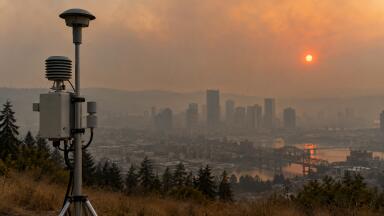
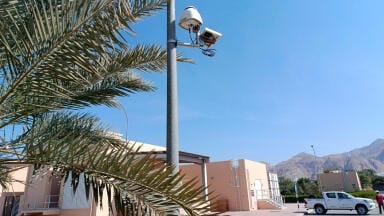
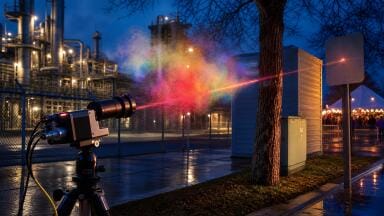
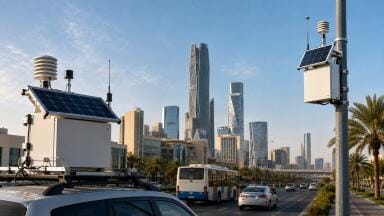
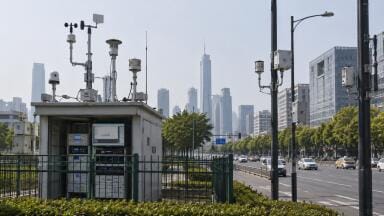
One of the ways to achieve this is with continuous air quality monitoring with publicly available real-time data.
Twenty years ago, this would have been horrendously expensive. But with the development of low-cost sensors, there is an enormous opportunity for monitoring to become so much better.
London has proved this with the Breathe London network of hundreds of monitors. It is about time that every town and city had the funding to do the same.
DEFRA can obviously help. But there is an enormous opportunity for developers to fund air quality monitoring.
If they are saying they won’t harm air quality…let’s make them prove it!
NB. Apologies and thanks go to Dr Ashley Mills and Prof. Stephen Peckham for allowing me to plagiarise the title of their Paper: Garbage in, gospel out? – Air quality assessment in the UK planning system. Environmental Science and Policy, 101. pp. 211-220. ISSN 1462-9011
IET 36.5 Sept/Oct 2026


 Product directory




.jpg)


















.jpg)