Water/wastewater
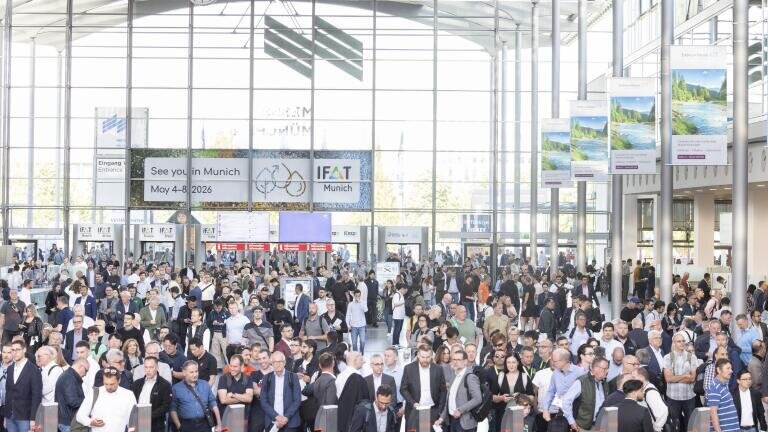
Reducing reliance on critical raw materials is becoming a central concern for industry and policymakers alike, particularly as supply chains remain fragile and geopolitical tensions continue to influence global trade. At IFAT Munich 2026, organisers plan to place the circular economy at the centre of discussions, highlighting how recycling, digital technologies, and cross-sector collaboration can help strengthen resource security and economic resilience. The environmental technology trade fair will take place in Munich from 4-7 May 2026.
As the event approaches its 60-year milestone, its themes are closely aligned with current global economic challenges. Pressure on raw material supplies has brought recycling and circularity into sharper focus across Europe, where governments and industry increasingly view closed material loops as essential for maintaining industrial competitiveness while reducing dependence on imported resources.
Policy developments are also shaping this agenda. In late 2025, the European Commission introduced the RESourceEU initiative, outlining measures aimed at improving resource efficiency across the bloc. The plan includes financial support for circular practices as well as potential export restrictions on certain waste materials, such as aluminium scrap and magnet waste, to encourage domestic recycling capacity. Additional proposals include new battery labelling requirements and incentives designed to strengthen battery recycling systems.
Exhibitors attending IFAT Munich are expected to present a range of technologies designed to improve resource recovery and material reuse. Among the innovations highlighted by organisers are new lithium-ion battery recycling processes, developments in automotive recycling, and digital tools designed to improve the identification and separation of recyclable materials.
These themes will also feature prominently in the conference programme. The Orange Stage in Hall A5 will host a series of panel discussions exploring strategies for building a more resilient circular economy. The sessions are being organised with the participation of several German institutions and industry groups, including the Federal Association of the German Waste, Water and Circular Economy Management Industry (BDE), Germany Trade & Invest (GTAI), the German Federal Environmental Foundation (DBU), and the Federal Ministry for the Environment.
One sector drawing particular attention is the automotive industry, which relies heavily on raw materials and is undergoing major technological change due to electrification. European policymakers are working to increase material recovery rates and keep valuable resources circulating within the region.
These goals are reflected in the proposed End-of-Life Vehicles Regulation (ELV-R), which is currently progressing through the EU legislative process. The regulation introduces higher recycling targets, promotes the use of recycled plastics in vehicles, and proposes a digital vehicle passport designed to make dismantling and material recovery easier.
At the same time, the rapid growth of electric vehicles is increasing the importance of recycling lithium-ion batteries. These batteries contain critical materials such as lithium, nickel, cobalt, and graphite. Although technologies capable of recovering large portions of these materials already exist, the financial viability of recycling operations remains sensitive to fluctuations in commodity markets. Nevertheless, new recycling facilities are beginning to emerge across Europe as the industry prepares for rising battery volumes.
Several IFAT sessions will examine these developments. Experts from both the automotive and recycling sectors are expected to discuss topics such as urban mining, the development of closed-loop material systems, and new forms of cooperation across supply chains.
Additional discussions will address extended producer responsibility schemes, including the recycling of used tyres and industrial methods for extracting critical materials from spent batteries. Organisations contributing to these sessions include BDE, the Bavarian Resource Efficiency Centre (REZ), the Federal Association for Secondary Raw Materials and Disposal (bvse), and the Mechanical Engineering Industry Association (VDMA).
Alongside panel discussions and technical presentations, visitors will also be able to observe practical demonstrations. One example is an outdoor showcase organised by the Federal Association of German Steel Recycling and Disposal Companies (BDSV), which will demonstrate modern mechanical dismantling processes under the theme of “Green Steel”.
Artificial intelligence, robotics, and advanced digital systems are increasingly shaping how recycling and waste management operations function. Industry participants expect these tools to improve sorting accuracy, streamline operations, enhance worker safety, and reduce emissions throughout the waste management chain.
Municipal waste services are also exploring these technologies. AI-based tools can help reduce incorrect waste sorting and improve route planning for collection vehicles, potentially lowering operational costs and emissions. These applications will be discussed during a session organised by the German Association of Local Utilities (VKU).
Meanwhile, the VDMA plans to introduce an initiative aimed at standardising data exchange between sensor-based sorting systems. The goal is to enable more intelligent and interconnected recycling processes. Another discussion will examine the role of digital product passports, which could help track materials through their lifecycle and improve recycling outcomes.
The final day of IFAT Munich will also feature a critical examination of new technologies. The International Solid Waste Association (ISWA) will host a session exploring both the potential and the limitations of AI and robotics in waste management.
Topics are expected to include collaborative robots designed to dismantle complex electronic equipment, AI-assisted material recovery systems, and digital tools for tracking material flows. However, speakers will also address the practical barriers that remain.
AI systems require large amounts of reliable, standardised data to function effectively. In real waste management environments, materials are often highly variable and contaminated, which can limit the performance of automated systems compared with controlled laboratory conditions. In addition, the capital costs associated with advanced robotics and AI can be significant, particularly for smaller recycling facilities or operators in low- and middle-income countries.
These challenges are particularly relevant given that the fastest growth in global waste volumes is expected to occur in developing regions. ISWA argues that future progress will depend not only on technological innovation but also on the development of practical and scalable waste management systems capable of working across different economic contexts.
IET 36.5 Sept/Oct 2026


 Product directory




.jpg)









.jpg)








.jpg)