Air monitoring
Those few reference‑grade stations produced sparse readings that were often delayed and seldom accessible to the public.
In December 2024, Kathmandu Metropolitan City (KMC) broke with that model.
Supported by the Partnership for Healthy Cities (a Bloomberg Philanthropies initiative implemented by the National Federation of Youth NGO), the city began installing its own 18 Clarity Node‑S monitors, which measure fine particulate pollution (PM₂.₅).
What makes KMC’s move significant is its independence: the network is funded and operated by the city.
Local officials note that the sensors are solar‑powered and have built‑in data connectivity, meaning they require no external power or Wi‑Fi, and deliver real‑time data to a central dashboard.
Calibration is undertaken through co‑location with national reference stations, with methods aligned to US EPA standards.
City officials argue that this ensures the new system supplements rather than replaces the national network, while providing hyperlocal information needed for neighbourhood‑scale interventions.
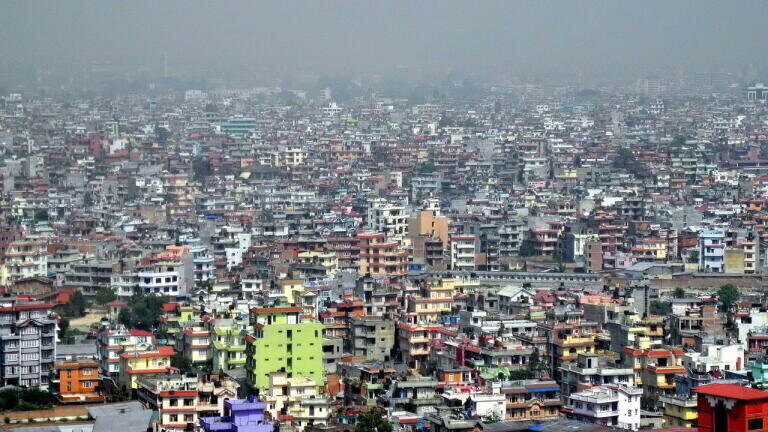
Kathmandu is one of the world’s most polluted cities; particulate levels regularly spike above World Health Organisation guidelines, and hospitals see surges in respiratory illnesses throughout the year.
Frustration with data gaps and with the government’s slow progress on air pollution, motivated KMC to act.
Officials describe the deployment as the first time a local government in Nepal has established an independent air‑quality monitoring system.
The network will feed data into mobile apps and public dashboards, giving residents visibility previously reserved for national regulators.
Each Clarity Node‑S monitor integrates a low‑cost optical particle counter with a cellular modem and solar panel.
The solar‑powered operation eliminates the need for grid connection, while built‑in connectivity allows real‑time transmission to KMC servers and dashboards.
To ensure credibility, KMC and the Department of Environment co‑located and calibrated the sensors against reference instruments using EPA‑aligned methods.
This calibration is critical because a low‑cost sensor can drift over time.
Instrumentation suppliers should note that these devices are being installed on rooftops of municipal buildings, hospitals, schools and temples, requiring ruggedised enclosures and flexible mounting options.
Because they are networked, they also need secure data protocols and user‑friendly software for public display.
City officials have already declared the lunar month of Poush (December/January) ‘Air Pollution Awareness Month’, with educational campaigns and targeted interventions.
Deputy Mayor Sunita Dangol has referenced car‑free Saturdays and strict penalties for open burning as measures informed by the new data.
These initiatives highlight how local data can underpin behavioural change.
Health authorities are using the live readings to coordinate with schools and hospitals, advising vulnerable populations when to stay indoors.
KMC’s initiative shows that municipal governments are emerging as buyers of environmental instrumentation, not just national regulators.
Local budgets and philanthropic partnerships can create micro‑markets for low‑cost, networked sensors.
The compact, solar‑powered Node‑S sensors prove that reference‑grade monitors are no longer the only option.
They are easy to deploy, provide real‑time data and can be scaled quickly across neighbourhoods.
However, suppliers must still deliver calibration protocols to maintain trust.
Data from each sensor is being integrated into public dashboards and mobile apps, inviting citizens, media and civil society to scrutinise pollution levels.
Health departments, NGOs and advocacy groups are already using this information to campaign for traffic management and waste‑burning bans.
For vendors, this means products must offer transparent data access and be ready for community engagement.
For equipment suppliers, KMC’s deployment underscores the need for plug‑and‑play devices that cities can maintain themselves.
Solar power and cellular connectivity are essential in regions where power cuts and poor internet service are common.
Sensor kits that include calibration kits and clear maintenance instructions can differentiate suppliers.
Data service providers can add value through visualisation, analytics and alert systems.
In Kathmandu, the sensor data will feed into a public portal and mobile app, enabling alerts and historical analysis.
There is an opportunity to develop algorithms that correlate pollution spikes with traffic patterns, weather and open burning, giving city planners actionable insights.
With millions of vehicle journeys a day, Kathmandu’s roads are a major pollution source.
If rooftop sensors can influence transport policy, the city could set a precedent for other South Asian metropolises.
Officials from Pokhara, Bharatpur and Patan have reportedly expressed interest in similar networks.
The project also illustrates how philanthropic funding can catalyse municipal innovation, especially in countries where national resources are stretched.
For instrumentation professionals, Kathmandu is a reminder that the centre of gravity is shifting.
Local governments, armed with off‑grid sensors and public dashboards, are no longer waiting for national authorities to act.
The city’s modest network may be small but its effects could be large, pushing environmental monitoring from the margins into the mainstream of urban governance.
IET Guide 2026

 Product directory















.jpg)



.jpg)




.jpg)