Soil testing
Published over 13 years ago. See the latest and most current information on Soil testing.
A new ASTM (USA) International standard will be used by contractors and government agencies for quality control and quality assurance of electromagnetic soil density gauges.
ASTM D7830, Test Method for In-Place Determination of Density (Unit Weight) and Water Content of Soil Using an Electromagnetic Soil Density Gauge, was developed by Subcommittee D18.08 on Special and Construction Control Tests, which is part of ASTM International Committee D18 on Soil and Rock.
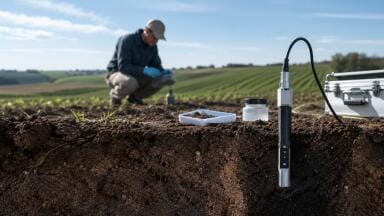
The new standard covers procedures for determining in-place properties of non-frozen, unbound soil and soil aggregate mixtures, such as total density, gravimetric water content and relative compaction by measuring the electromagnetic impedance of the compacted soil. The test described in ASTM D7830 focuses on the use of electrical, non-nuclear devices to determine in-place density and moisture content.
Ronald Berube, engineering manager, QCQA Labs, and a D18 member, says that ASTM D7830 will be used by buyers, owners and designers of civil infrastructure projects. According to Berube, the gauge covered by the standard uses a distinctly different technique to perform the same function as the tests described in other D18.08 standards such as D1556, Test Method for Density and Unit Weight of Soil in Place by the Sand-Cone Method; D6780, Test Method for Water Content and Density of Soil In Situ by Time Domain Reflectrometry (TDR); and D6938, Test Method for In-Place Density and Water Content of Soil and Soil-Aggregate by Nuclear Methods (Shallow Depth).
ASTM International is one of the largest international standards development and delivery systems in the world. ASTM International meets the World Trade Organisation (WTO) principles for the development of international standards: coherence, consensus, development dimension, effectiveness, impartiality, openness, relevance and transparency. ASTM standards are accepted and used in research and development, product testing, quality systems and commercial transactions.
IET 36.5 Sept/Oct 2026





 Product directory