Portable & field testing
Published over 10 years ago. See the latest and most current information on Portable & field testing.
Lead is a toxic metal that is harmful to human health and any level of exposure is considered unsafe. Drinking water is only one of the possible routes of exposure to lead contamination, but it is one of the easiest routes of contamination to reduce. The primary source for lead in most drinking water sources is the piping used within a distribution system or household plumbing. Lead found in tap water usually comes from the corrosion of older fixtures or from the solder that connects pipes. When water sits in leaded pipes for several hours, lead can leach into the water supply.
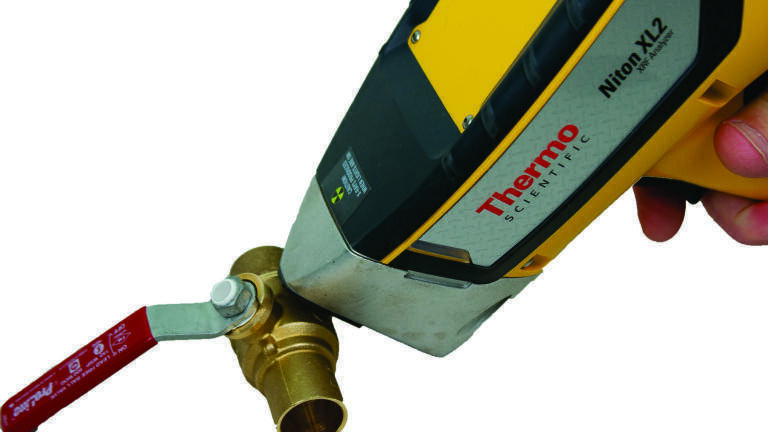
XRF (X-Ray Fluorescence) is one of the acceptable techniques for measuring the lead content of drinking water system components. XRF is a nondestructive testing technique that can analyse a metal sample in seconds with no need for sample preparation. Thermo Scientific (USA) Portable XRF Analysers determine the elemental composition of materials by measuring the fluorescent (or secondary) x-ray emitted from a sample when it is excited by a primary x-ray source. Each of the elements present in a sample produces a set of characteristic fluorescent x-rays (“a fingerprint”) that is unique for that specific element, which is why XRF spectroscopy is an excellent technology for qualitative and quantitative analysis of material composition.
IET 36.5 Sept/Oct 2026





 Product directory