Portable & field testing
Published over 12 years ago. See the latest and most current information on Portable & field testing.
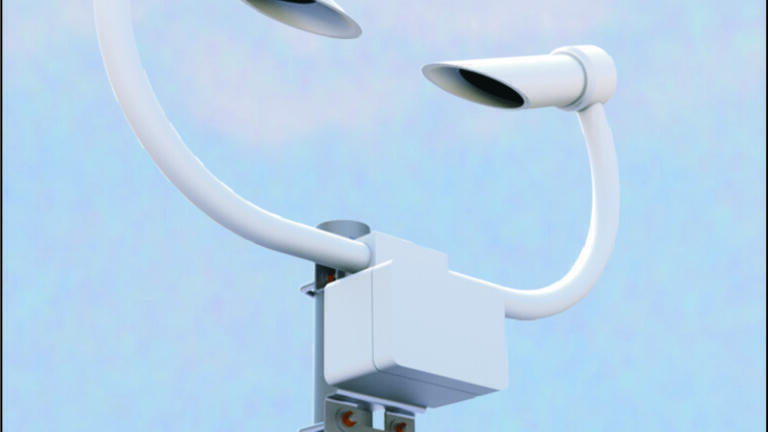
The CS120A Visibility Sensor from Campbell Scientific (UK) provides two user-configurable outputs which are typically used to drive external warning devices such as lights or fog-horns. However, these same outputs can also be used to switch the intensity of warning lights on wind turbines depending upon the ambient visibility.
This means that wind turbine warning lights, which can dazzle pilots or cause a nuisance to nearby residents, need only be on full intensity when visibility is reduced allowing a reduction in their output when conditions are clear.
The CS120A is a low power, high specification visibility sensor offered at a competitive price. Some similar sensors that operate in the near infra-red wavelengths experience problems when in the vicinity of obstruction lights. The CS120A has been tested against these lights and is proven to operate without interference. High speed sampling improves the accuracy of measurements taken.
The design of the CS120A places the measurement volume in a relatively 'clean' space because of the position of the heads and body which minimise airflow disturbance. The sensor hoods are downward pointing, which eliminates the possibility of sunlight shining directly into the lens detector and giving measurement errors – a well-known problem in some similar sensors. Contaminants also cannot fall into the sensor hoods.
Integrated low power heaters prevent the build-up of dew and higher powered anti-icing heaters are also included. All heaters are automatically controlled for simple operation in all weather types.
AET 30.4 Nov 2026


 Product directory