Leak detection
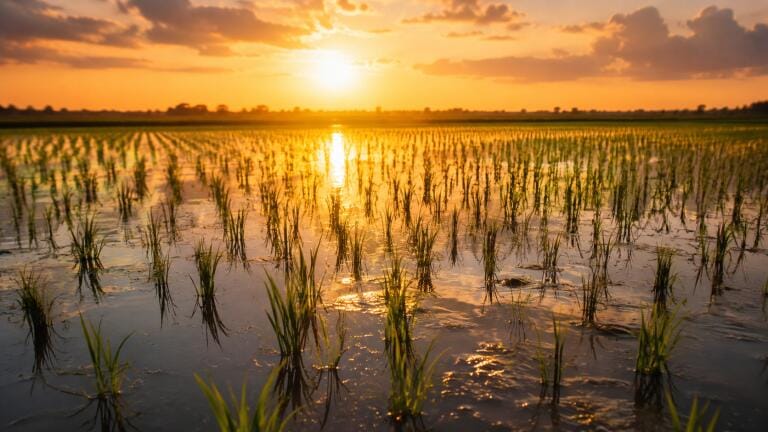
Rice paddies account for an estimated 8 to 12 per cent of global man-made methane emissions, but most national inventory teams currently rely on methods offering limited spatial detail and carrying significant uncertainty.
The project, funded by the CCAC and implemented by FAO's Office of Climate Change, Biodiversity and Environment together with its Regional Office for Asia and the Pacific, is developing an open-source framework intended to produce more accurate and detailed rice methane estimates.
The methodology is being piloted in Vietnam and Cambodia in collaboration with national ministries and research institutions.

The project launched on 13 March 2026 in Colombo, Sri Lanka, during the FAO Asia-Pacific and Central Asia Regional Workshop on Enhanced Transparency and Regional Cooperation on Climate Actions, which drew practitioners from 21 countries.
Listya Kusumawati, CCAC Programme Manager, said: ‘The CCAC stands ready to continue to support Vietnam and Cambodia's effort to reduce short-lived climate pollutants, strengthen agricultural policy, and demonstrate regional and global leadership in methane action.'
Leel Randeni, Director of Climate Change at Sri Lanka's Ministry of Environment, said: ‘With this technical advancement, we can go for more precise ways for preparing our greenhouse gas inventories, so that we can achieve, report and adhere to transparency principles better.'
H.E. Meas Sophal, Undersecretary of State at Cambodia's Ministry of Environment, said: ‘Regional collaboration is very important. From this project, we hope that by learning-from-doing and using our experience applying the tool, we can replicate our work across Cambodia and the region.'
Framework rollout is expected in both pilot countries later in 2026, with the methodology and guidance materials to be made openly available for other rice-producing countries.
IET 36.5 Sept/Oct 2026



 Product directory

















.jpg)