Industrial emissions
Framed as a transparency measure for developers and local communities, the site aggregates guidance and modelling tools relevant to the rapidly expanding digital infrastructure sector.
On paper, the move looks procedural: a centralised portal collating existing Clean Air Act material. In practice, it is a clear signal about where US federal air regulation is heading for one of the fastest growing, and most energy-intensive, classes of industrial infrastructure.
For environmental monitoring professionals, the implications sit less in the rhetoric around AI leadership and more in how air permitting and emissions modelling may evolve over the next decade.
Data centres were not a major regulatory concern when much of the Clean Air Act’s stationary source framework was developed in the 1990s.
Today, they sit at the intersection of several regulatory pressure points.
Large numbers of stationary diesel and gas-fired generators, often permitted as emergency backup, are increasingly run for grid support.
Combustion turbines are being deployed for on-site or near-site power.
Facilities are clustering geographically, creating cumulative air quality impacts, and there is growing tension between ‘temporary’ or ‘emergency’ classifications and near-continuous operational realities.
For regulators, this creates uncertainty over how to apply New Source Performance Standards, National Emission Standards for Hazardous Air Pollutants, and Prevention of Significant Deterioration requirements.
The new EPA webpage is explicitly designed to reduce that uncertainty, but largely by clarifying how existing rules are interpreted rather than by strengthening or modernising them.
This section centres on stationary engines and turbines, reflecting the reality that power provision, not computing hardware, is the dominant air quality issue for data centres.
It links to existing rules governing NOₓ, SO₂, particulate matter, and hazardous air pollutants from combustion sources, particularly those classified as emergency or non-emergency generators.
For monitoring specialists, this reinforces where regulatory scrutiny will continue to sit: stack emissions, fuel choice, operating hours, and compliance verification.
What is notable is the absence of new guidance on persistent monitoring gaps, such as real-world generator run-time verification or aggregated emissions accounting across multi-building data centre campuses.
The air permitting section aggregates historical EPA guidance documents, interpretive letters, and responses to state-level permitting questions.
Its importance lies not in introducing new standards, but in codifying precedent.
Developers and permitting authorities can now more easily see how EPA has historically interpreted its statutory obligations and where flexibility has been allowed.
For environmental monitoring professionals, this suggests continued demand for defensible modelling, emissions inventories, and reporting that supports permit applications and demonstrates compliance under PSD thresholds, rather than a shift toward more stringent or real-time measurement requirements.
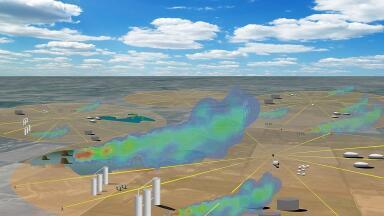
The modelling section points users to EPA’s Guideline on Air Quality Models, including the agency’s preferred dispersion models for use in PSD permitting.
Despite repeated references to streamlining, this confirms that air quality modelling remains the primary gatekeeper for data centre development.
Model choice, emissions assumptions, meteorological data, and input quality will continue to determine whether projects trigger major source thresholds.
For those supplying or operating monitoring systems, this sustains demand for high-quality emissions data that can support or validate modelling outcomes.
EPA has strongly emphasised cooperative federalism, presenting the webpage as a tool to help states, Tribes, and developers align more easily on Clean Air Act requirements.
OAR staff have also committed to case-by-case consultation with permitting authorities and individual facilities.
In practice, this points toward greater decentralisation rather than uniform deregulation.
For monitoring professionals, it suggests a more fragmented regulatory landscape in which state-level decisions matter more, monitoring requirements may diverge significantly by jurisdiction, and instrumentation strategies need to be adaptable rather than standardised.
This is particularly relevant in regions where multiple data centres are being developed in close proximity and cumulative impacts are politically contested.
The announcement repeatedly notes that many Clean Air Act requirements date back to the 1990s and have not kept pace with technological change.
However, the agency’s response stops short of a substantive update to emissions standards or monitoring expectations.
There is no new guidance on continuous emissions monitoring for generator fleets, no explicit framework for assessing cumulative regional impacts from clustered development, no linkage between air permitting and longer-term decarbonisation trajectories, and no commitment to expanding public or community-facing access to monitoring data.
The emphasis is on permitting efficiency rather than expanding the environmental intelligence base underpinning regulatory decisions.
For those working in air quality and emissions monitoring, the launch of this resource is more about demand signals than new obligations.
Permitting-driven monitoring and modelling support are likely to remain growth areas. Instrumentation that supports generator emissions characterisation will stay relevant for as long as backup power remains fossil-based.
There is likely to be increased emphasis on defensible data that satisfies regulators, rather than denser or more precautionary measurement networks.
At the same time, community groups and Tribes may seek independent monitoring to counterbalance developer-led assessments, creating parallel demand outside formal permitting processes.
The Clean Air Act Resource for Data Centres is best understood as a stabilisation measure.
It reduces regulatory ambiguity at a moment when data centre construction is accelerating, electricity demand is rising, and political pressure to prioritise AI infrastructure is intensifying.
For environmental monitoring professionals, it does not fundamentally change how air quality compliance works.
What it does change is the pace. Projects are likely to move faster, with less tolerance for experimental monitoring regimes or precautionary approaches.
The unresolved question is whether future air quality impacts linked to data centre growth will be easier to prevent, or simply easier to permit.
IET Guide 2026

 Product directory























.jpg)