Gas sensors
Plasmonic nanoparticles, photonic crystal cavities, and integrated waveguides are all designed to manipulate light–matter interactions at dimensions of just a few nanometres.
In this regime, small variations in geometry or fabrication can lead to large differences in sensitivity, selectivity, and stability.
A recent technique, scanning-exciton optical nanoscopy (SEON), offers a way to directly observe these effects. While not a sensing technology in itself, SEON provides a new level of visibility into the optical environments that underpin next-generation gas sensors.
Many advanced optical gas sensors are designed using electromagnetic simulations that predict where optical “hotspots” will form, how strongly light is confined, and how efficiently energy couples into or out of a structure.
In practice, real devices often deviate from these models due to fabrication tolerances, surface roughness or material inconsistencies.
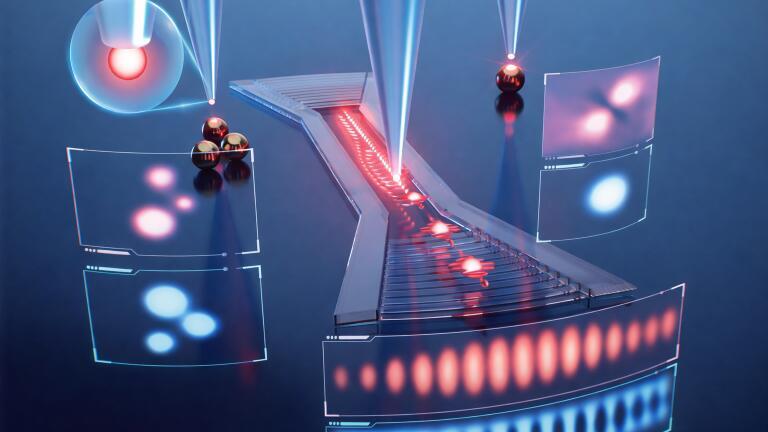
SEON addresses this gap by enabling direct, nanoscale mapping of two critical parameters: light-field intensity, which determines how strongly light interacts with gas molecules, and the local density of optical states (LDOS), which governs emission behaviour, decay rates and coupling efficiency.
By scanning a quantum-dot probe across a nanostructure, the technique produces spatial maps of both quantities with resolution down to a few nanometres, allowing researchers to verify how a device actually behaves under real conditions.
This has immediate implications for plasmonic sensing. Technologies based on localised surface plasmon resonance or surface-enhanced Raman scattering depend on highly localised electromagnetic hotspots that amplify optical signals and enable trace gas detection.
However, these hotspots are extremely sensitive to nanoscale geometry. Slight deviations in particle spacing or morphology can shift, weaken, or even eliminate the expected enhancement.
SEON makes it possible to directly locate and quantify these hotspots, rather than inferring them from far-field measurements, and to identify regions within a structure that are underperforming.
This creates a pathway toward more reliable optimisation of nanoparticle arrangements and more consistent sensor performance, particularly in applications such as methane leak detection or VOC monitoring where low detection limits are essential.
Beyond plasmonics, SEON is equally relevant to photonic crystal and waveguide-based gas sensors, which are increasingly being developed for compact and integrated platforms. In these systems, performance depends on how effectively light is confined and how strongly it interacts with the surrounding medium.
The LDOS plays a central role in this process, influencing emission rates and coupling efficiency within cavities and waveguides. By mapping LDOS directly, SEON allows designers to assess how well photonic structures support the desired optical modes and to fine-tune resonance conditions for stronger gas–light interaction.
This is particularly important in lab-on-chip devices, where tight integration leaves little tolerance for inefficiencies.
Another important contribution lies in the ability to separate overlapping physical effects. In practical optical gas sensors, changes in signal intensity can arise from multiple sources, including illumination conditions, scattering, and genuine interactions with target gases.
Because SEON simultaneously measures both light intensity and LDOS, it enables these contributions to be disentangled at the nanoscale.
This improves confidence in sensor calibration and helps reduce the risk of false positives or signal drift, both of which are critical concerns in regulatory and safety-focused monitoring environments.
A further implication is in the development of multi-parameter optical sensors, where a single platform is designed to detect multiple gases or environmental variables simultaneously.
These systems often rely on carefully engineered spectral responses or spatially distinct sensing regions within a nanophotonic structure. SEON’s ability to map optical behaviour with nanometre precision could support the design of such multiplexed systems, ensuring that each sensing channel operates independently and without unintended cross-talk.
There are also potential links to emerging quantum and hybrid sensing approaches, where quantum emitters, defects or nanocrystals are integrated into photonic structures to enhance sensitivity or enable new detection mechanisms.
In these cases, LDOS becomes even more critical, as it directly influences emission lifetimes, coherence and coupling into optical modes. SEON provides a way to characterise these interactions in situ, offering insight into how quantum-scale effects translate into measurable sensor performance.
SEON offers a means of verifying optical functionality at the nanoscale, which could complement existing metrology tools focused on structural or material properties.
SEON remains a laboratory technique, requiring a scanning probe with a quantum-dot tip, and is not intended for field deployment. Its value lies in accelerating the development and refinement of sensing technologies rather than replacing them.
By bridging the gap between simulation and fabricated devices, it enables more efficient design iteration and greater reproducibility across sensor platforms.
As optical gas sensing continues to evolve toward integrated photonics, quantum-enhanced detection, and ultra-low concentration monitoring, the ability to precisely control and verify nanoscale optical behaviour will become increasingly important.
Techniques such as SEON do not detect gases directly, but they provide the insight needed to ensure that the devices designed to do so operate as intended. In that sense, they represent an enabling layer in the sensing stack, with the potential to underpin the next generation of high-performance optical gas sensors.
IET Guide 2026

 Product directory