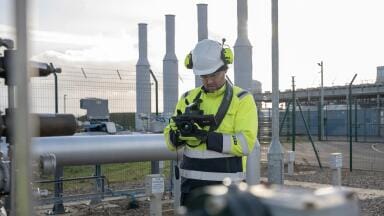
Fixed gas detector
Oil and gas operators, coal mines, landfill sites, agricultural systems and waste facilities are under increasing pressure to detect, quantify and report emissions.
That is where the commercial market is strongest: leak detection, continuous fence-line monitoring, drone surveys, satellite screening, measurement-informed inventories and methane MRV platforms.

Permafrost methane sits in a different category. It is not an industrial leak that can be repaired, and it is not yet subject to the same kind of routine compliance requirement.
But over the next decade it is likely to become a larger part of the methane measurement industry, because it connects three trends that are already gaining force: climate early warning, natural-source methane accounting, and the expansion of real-time environmental observation.
The case for more monitoring is simple. Thawing permafrost can release carbon dioxide and methane as previously frozen organic carbon becomes available for microbial decomposition.
Permafrost is already recognised by the Global Climate Observing System as an Essential Climate Variable, with required products including permafrost temperature, active-layer thickness and rock glacier velocity.
GCOS links changes in these variables to terrain stability, coastal erosion, water systems, the carbon cycle and vegetation development. That makes permafrost more than a scientific curiosity; it is already part of the formal climate-observation architecture.
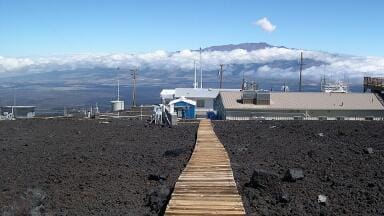
Woodwell Climate Research Center’s Permafrost Pathways programme states that only a handful of greenhouse-gas monitoring towers across the Arctic currently run year-round and measure both carbon dioxide and methane at landscape scale.
It also notes that around 80% of Arctic lands are not represented by current year-round carbon dioxide and methane monitoring sites. For an industry used to thinking in terms of representative networks, calibration, validation and data completeness, that is a major infrastructure gap.
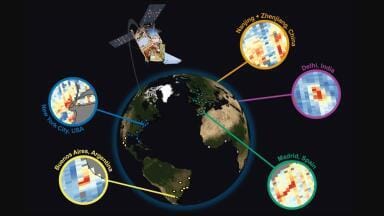
This matters because methane monitoring is moving beyond point-source regulation. The IEA’s Global Methane Tracker 2026 says countries are making methane reductions a policy priority, and that its latest estimates draw on satellite data and measurement campaigns.
The same report also refers to a framework to help countries respond to satellite-detected large-emission events. That policy and technology ecosystem is still mainly focused on anthropogenic emissions, but it is creating the tools, expectations and commercial models that could later be extended to natural and climate-driven methane sources.
A recent Woodwell-led paper goes further, calling for an integrated global methane observation system to track emissions from natural ecosystems in near real time. The authors argue that natural methane sources, including tropical wetlands and thawing permafrost, remain underrepresented in methane budgets and decision-making, despite making up a large share of the global methane budget.
That is probably the clearest signal of where the next phase of the debate is going.
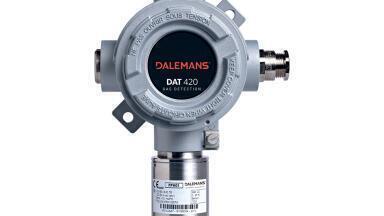
 Innovating more appropriate gas sensors
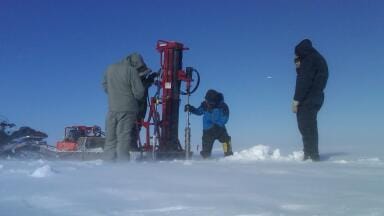
For monitoring professionals, the key phrase is near real time. Permafrost methane is currently studied through flux towers, chambers, borehole temperature monitoring, aircraft campaigns, satellite products and models. But these systems are unevenly distributed, expensive to maintain and often designed for research rather than operational warning. The emerging opportunity is to make permafrost monitoring more continuous, automated, lower-maintenance and interoperable.
That is where real-time mesh networks become relevant. In December 2025, Natural Resources Canada announced funding for methane measurement and mitigation technologies, including a project to build and deploy a real-time mesh network for methane monitoring that is economical at scale and can operate in off-grid facilities.
The same funding package also included projects on methane MRV standardisation, drone-mounted methane detection, aerial quantification and large-scale multi-sensor MMRV platforms. These projects are aimed at energy and waste-sector emissions rather than permafrost. However, the technology logic is highly transferable: low-power sensors, distributed nodes, off-grid operation, local communications, automated data transfer, source localisation and integration with modelling platforms.
In a permafrost setting, a mesh network would not replace flux towers or satellites. It would sit between them. Nodes could be deployed around thaw lakes, thermokarst features, wetlands, infrastructure corridors, coastal erosion zones or research transects.
Each node might measure methane concentration alongside wind, pressure, humidity, soil temperature, ground movement, water level or snow conditions. Data could be passed between nodes to a gateway, then into a cloud platform for anomaly detection, trend analysis and model assimilation.
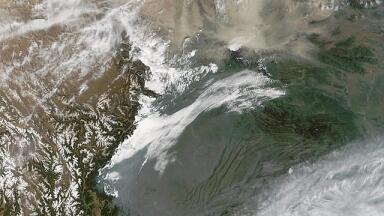
The appeal is obvious. Satellites can provide regional context, but they struggle with cloud, snow, low sun angles, retrieval uncertainty and source attribution in Arctic conditions.
ESA’s Permafrost CCI project notes that permafrost cannot be directly detected from space, although surface features, landforms, land-surface temperature, snow-water equivalent and landscape dynamics can be observed and used to produce permafrost products. Ground systems are therefore essential for validation and for capturing short-lived or localised events that satellites may miss.
The EU-funded MISO project shows how this kind of instrumentation pathway is already developing. The project is designed to detect and quantify carbon dioxide and methane in remote permafrost and wetland areas using improved NDIR greenhouse-gas sensors, static towers, chambers and UAV-mounted sensors.
It is intended for hard-to-reach areas, harsh environments and minimum on-site intervention, with data transmitted using cloud-based communications.
That is very close to the kind of architecture likely to matter for future permafrost methane monitoring: robust sensors, autonomous deployment, aerial support, low maintenance and digital data workflows.
The early-warning framing strengthens the case. The WMO-led Early Warnings for All initiative aims to ensure protection from hazardous weather, water and climate events by the end of 2027, and identifies detection, observation, monitoring, analysis and forecasting as one of the core pillars of warning systems. Permafrost methane is not a warning problem in the same way as a flood or heatwave.
There may be no immediate evacuation trigger. But permafrost thaw affects infrastructure stability, coastal erosion, hydrology, wildfire risk, community safety and climate feedbacks. That makes it part of the wider shift from periodic environmental assessment to continuous climate-risk surveillance.
The commercial opportunity is therefore likely to emerge in layers.
The first layer will be research infrastructure: more flux towers, chambers, borehole sensors, UAV surveys and Arctic field stations. The second will be data integration: platforms that combine ground sensors, satellite products, weather data, land-cover change, hydrology and carbon models. The third will be operational monitoring for infrastructure and communities, especially where thaw threatens roads, pipelines, settlements, military assets, ports or coastal areas. The fourth, more speculative layer, is methane feedback MRV: systems designed to quantify how much climate-driven methane is entering the atmosphere from permafrost landscapes.
The major barrier is attribution. A methane sensor can detect methane. It cannot automatically say whether that methane came from thawing permafrost, a wetland, a lake, a fire, a leaking fuel system or a geological seep.
For permafrost methane monitoring to become operationally useful, measurement systems will need meteorology, isotopic analysis in some cases, dispersion modelling, land-surface data, seasonal baselines and repeated validation from chambers, towers, drones and aircraft. The industry opportunity is not simply selling more methane sensors; it is building measurement systems that can support defensible interpretation.
So the answer is yes, but with an important caveat. Permafrost methane is unlikely to become a large, standalone compliance market in the next decade in the way oil and gas methane has become.
There are no operators to fine, no valve to close and no simple mitigation pathway once emissions are coming from thawing ground. But it is likely to become a larger part of the methane measurement industry through Arctic observing networks, climate-risk monitoring, satellite validation, autonomous field instrumentation, natural-source methane accounting and early-warning data systems.
For instrumentation suppliers, the direction of travel is clear. The market is moving from occasional methane detection toward continuous, multi-scale methane intelligence.
Permafrost is one of the hardest use cases: remote, cold, spatially variable, biologically complex and politically significant. If systems can work there, they will also have relevance for wetlands, peatlands, landfills, abandoned wells, agricultural landscapes and other diffuse methane sources.
The next decade may therefore see permafrost methane monitoring become less of a specialist Arctic research activity and more of a proving ground for the next generation of methane measurement: autonomous, distributed, multi-sensor, model-linked and designed for climate-risk decisions rather than simple leak detection.
IET Guide 2026

 Product directory