Environmental laboratory
Published over 14 years ago. See the latest and most current information on Environmental laboratory.
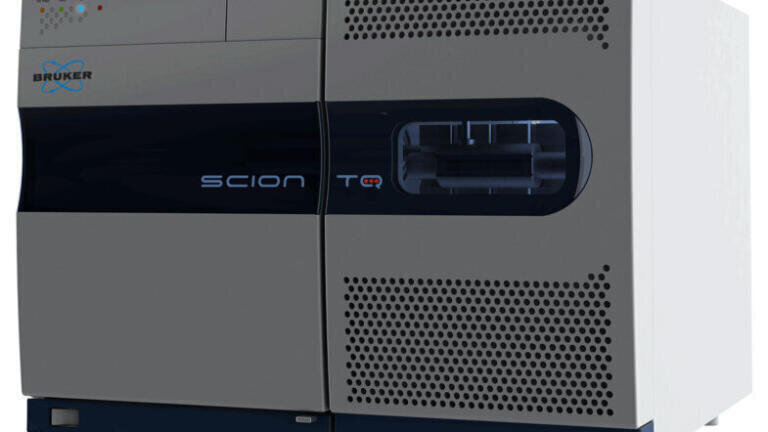
At the recent 49th JAIMA EXPO in Chiba, Japan, organisers estimated that visitors numbers in the region of 30,000 attended. It was at this event that Bruker (USA) demonstrated its innovative ‘lens-free’ elliptical ion path of the recently launched SCION™ single quadrupole (SQ) and SCION™ triple quadrupole (TQ) gas chromatography-mass spectrometry (GC-MS) detectors. The SCION SQ and TQ have a compact footprint while providing ultra-high sensitivity and outstanding data quality. The choice of two gas chromatographs (GC), the compact 436 GC and versatile 451 GC allows for system customisation using additional GC detectors and inlets.
The unique SCION design incorporates a legacy of expertise, innovative design and customer input leading to the development of a unique, elliptical ion path that not only reduces the overall size of the system but actually enhances performance and improves signal-to-noise. The footprint of the SCION TQ is a compact 50cm (19.5 in.) high x 38cm (15 in.) wide x 71cm (28 in.) deep; it is almost half the footprint of other systems and weighs in at only 40kg (88 lb).
“Our SCION GC-MS-triple quad system has tremendous analytical power and robustness but it has the footprint of an instrument as small, if not smaller, than any SQ GC-MS system on the market today,” stated Meredith Conoley, GC-MS Market Manager for Bruker’s Chemical & Applied Markets (CAM) division.
Bruker is focused on innovations that mean more to the end-user; “we incorporated seven design innovations in the triple quad to deliver higher sensitivity, better selectivity, robustness and ease of use. These design elements will make the transition from single to triple quadrupole an easier step. Additionally, the footprint will be the same as the instrument you are currently using, there will be no change in the laboratory footprint required, and we believe this is an underrated concept that laboratories really appreciate when they put the instrument on their all too valuable bench space”, said Conoley.
The SCION TQ MS also incorporates a multi-axis neutral noise cancelling technology, which creates four zones of noise cancelling by incorporating a 180° collision cell, a 90° q0 ion optic and by placing the detector at a 90° angle off the Q3, delivering ultra-high signal to noise (S/N) performance due to its elliptical ion path.
The patented, integrated, orthogonal post-filter detector provides superior low mass sensitivity and unmatched negative-ion detection without requiring multiplier calibration. Whilst the lens-free ion path increases mass stability and simplifies tuning. The system’s ion source uses dual filaments with rebound electron beam technology, while a high-capacity turbo pump enables fast pump-down for improved overall system robustness and significant improvements in reliability.
IET 36.5 Sept/Oct 2026





 Product directory