Drinking water
It does not create an immediate legal limit for microplastics but it still matters for laboratories, utilities, sampling specialists and monitoring technology suppliers because it does move microplastics formally into the US drinking-water policy pipeline.
The EPA announced in April 2026 that microplastics would be included as a priority contaminant group in draft CCL 6, alongside pharmaceuticals, PFAS, disinfection by-products, 75 individual chemicals and nine microbes.
Under the Safe Drinking Water Act, the Contaminant Candidate List identifies contaminants that are not currently subject to national primary drinking-water regulations, but which are known or anticipated to occur in public water systems and may require regulation in future.
The draft list was published in the Federal Register on 6 April 2026, with a public comment period running to 5 June 2026.

For monitoring professionals, the most important point is that the EPA has not simply identified another contaminant of concern. It has identified a contaminant category that remains difficult to define, sample, measure and interpret consistently.
Microplastics vary by polymer type, size, shape, colour, fibre form, surface chemistry and associated additives. That makes them very different from many conventional drinking-water contaminants, where the task is usually to quantify a named chemical against a defined concentration threshold.
This is why the policy signal is likely to create a methods problem before it creates a compliance problem. If microplastics move further through the regulatory process, drinking water systems will need data that can be compared across locations, laboratories and time periods.
That means standardised sampling, contamination control, particle identification, size classification, polymer analysis, QA/QC procedures and reporting formats. Without that, monitoring could produce numbers that are technically impressive but difficult for regulators, utilities or the public to interpret.
The EPA’s announcement also sits alongside a wider federal research effort. The Department of Health and Human Services’ ARPA-H programme has launched STOMP, or Systematic Targeting of Microplastics, which is intended to build tools for measuring, researching and removing microplastics and nanoplastics from the human body.
SCI reports that the programme is backed by $144 million and includes work on “gold-standard” microplastic measurement methods.
That is relevant to water monitoring because health-based regulation depends on more than detecting particles in drinking water. Regulators also need to understand which particles matter most.
A large polyethylene fragment, a PET fibre, a tyre-wear particle and a nanoplastic particle may not carry the same exposure profile or toxicological relevance.
Future monitoring frameworks may therefore need to move beyond simple particle counts and towards more detailed characterisation of polymer type, particle size, morphology and potential chemical associations.
International work already points in this direction. The European Commission’s Joint Research Centre has developed a methodology to support microplastics monitoring under the EU Drinking Water Directive, noting that measurement is challenging because microplastics vary widely in size, shape, composition and chemical identity.
The JRC approach is designed to harmonise sampling, analysis and data reporting, using large sample volumes, filtration and analysis by infrared or Raman microscopy to identify polymer type, particle size and particle or fibre form.
California provides another useful comparison. The State Water Resources Control Board was required to adopt a definition of microplastics in drinking water, develop a standard testing methodology and establish four years of testing and reporting, including public disclosure.
Its work involved method development, inter-laboratory comparison and evaluation of infrared and Raman spectroscopy for microplastic identification.
For laboratories, this is likely to be the main opportunity. Microplastics analysis is technically demanding, especially at low concentrations and smaller particle sizes.
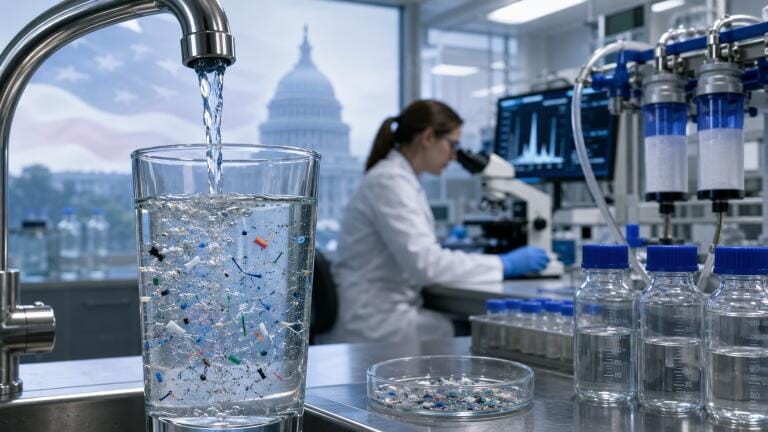
Sampling equipment, laboratory air, clothing, containers and procedural blanks can all affect results. Labs able to demonstrate robust contamination control, validated spectroscopy methods and defensible reporting will be better placed if monitoring requirements expand.
For water utilities, the challenge is more strategic. Inclusion on the CCL does not mean utilities must immediately monitor or treat for microplastics under a federal standard.
However, it does suggest that microplastics could become part of future information collection, research programmes or regulatory determinations.
Utilities may need to understand where particles enter their systems, how effectively existing treatment processes remove them, and whether distribution networks, pipe materials or household plumbing contribute to final exposure.
Treatment suppliers should also watch the issue carefully. Conventional drinking-water treatment may remove a proportion of larger particles, but future regulatory concern may focus on smaller particles, fibres or nanoplastics that are harder to capture and harder to measure.
If policy moves towards treatment-performance expectations, suppliers of filtration, membrane, activated carbon or advanced treatment systems will need credible evidence of removal efficiency across particle types and size ranges.

The World Health Organization has previously argued that evidence on microplastics in drinking water remains incomplete and that more work is needed on occurrence, health impacts and removal during wastewater and drinking-water treatment.
That uncertainty is precisely what makes the EPA’s move significant for the monitoring sector. It formalises microplastics as a drinking-water research and policy priority, while leaving the technical measurement questions open.
For environmental monitoring professionals, the message is clear. Microplastics are moving from an emerging research concern towards formal drinking-water policy consideration.
The immediate market impact is unlikely to be a sudden compliance requirement. It is more likely to be growing demand for standardised methods, validated laboratory capacity, comparable datasets and treatment-performance evidence.
The EPA’s CCL 6 proposal therefore matters even before any regulatory limit is set. It signals that future drinking water protection will depend not only on detecting familiar dissolved contaminants, but on characterising complex particulate pollution in a way that regulators, utilities and consumers can trust.
IET Guide 2026

 Product directory