Portable & field testing
A recent review of advanced data analytics for on-farm experimentation argues that this shift could change how agronomic knowledge is produced.
Instead of relying only on small, controlled research station trials, farmers and researchers can use real working fields to test fertiliser rates, seed density, crop management strategies and site-specific interventions under actual production conditions.
For environmental monitoring professionals, the implications go beyond crop yield.
The same systems that help farmers decide where to apply nitrogen, adjust irrigation or vary seed rates also generate data relevant to nutrient efficiency, soil condition, diffuse pollution risk and climate-smart land management.
But the value of that data depends heavily on whether it is collected, processed and interpreted correctly.

Traditional agronomic experiments are designed to control complexity. Plots are carefully arranged, treatments are replicated, and statistical methods are chosen to isolate cause and effect.
Real farms do not behave like that.
Soil texture, organic matter, compaction, drainage, slope, previous cropping, weather exposure and machinery paths can all vary across the same field. A higher yield in one part of a field may be caused by a treatment, but it may also reflect better soil, lower waterlogging, different weed pressure or a historic management effect.
This is where monitoring design becomes critical.
If a fertiliser trial is laid out without accounting for soil variability, the resulting dataset may look precise while still giving the wrong answer. If sensor readings are not calibrated, georeferenced or cleaned properly, the error can travel all the way through the analytical pipeline and into the recommendation given to the farmer.
For monitoring professionals, this is a familiar problem. Data quality is not created at the modelling stage. It begins with the sampling strategy, the instrument, the field conditions, the metadata and the quality assurance process.
The review highlights several analytical approaches that are becoming important in on-farm experimentation, including linear mixed models, Bayesian spatial methods, permutation-based techniques and machine learning.
Their purpose is not simply to make farm data look more sophisticated. It is to deal with the reality that field-scale datasets are spatially complex, uneven and often only lightly replicated.
Linear mixed models can help account for spatial variability. Bayesian approaches can express results as probabilities rather than simple pass-or-fail significance tests. Machine learning can detect nonlinear relationships across large datasets, particularly where yield response depends on interacting soil, weather and management factors.
But the warning is clear: better algorithms do not remove the need for better evidence.
A model may predict yield accurately without correctly identifying why yield changed. That distinction matters when recommendations affect fertiliser use, pesticide decisions, irrigation, soil amendments or other interventions with environmental consequences.
For example, if a model wrongly attributes yield improvement to additional nitrogen when the underlying cause is soil structure or moisture availability, the result could be over-application. That has direct relevance to nitrate leaching, nitrous oxide emissions, input costs and water quality.
This creates a clear role for the environmental monitoring sector.
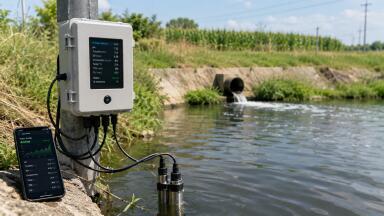
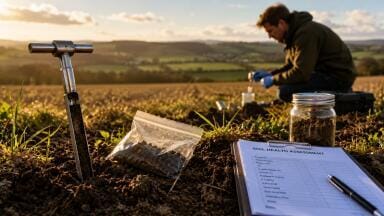
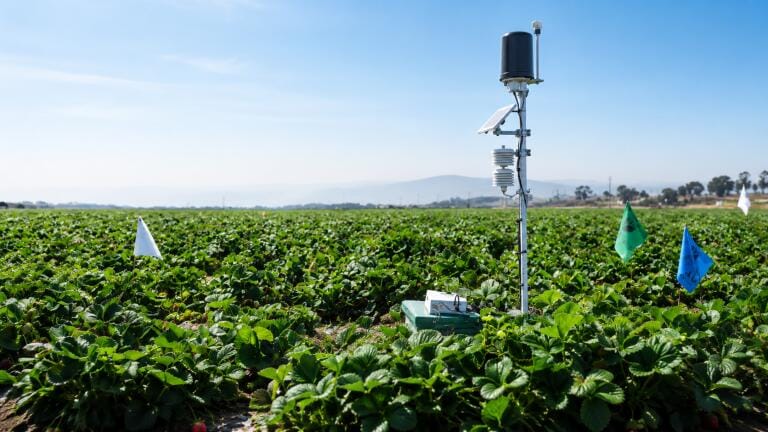
On-farm experimentation needs reliable field data, but that data does not come from one instrument alone. It may combine soil testing, yield mapping, crop imaging, weather stations, remote sensing, water monitoring, nutrient budgets and management records.
The opportunity is to build evidence networks rather than isolated datasets.
A farmer testing variable nitrogen rates may need soil nitrate data, organic matter measurements, yield maps, rainfall information and possibly runoff or drainage monitoring.
A catchment partnership looking at diffuse pollution may need to connect farm-scale management data with water quality signals downstream. A soil carbon project may need repeated measurements, robust baselines and statistical methods that can separate management effects from natural variability.
In each case, instrumentation is only part of the system. The larger challenge is turning measurements into defensible evidence.
That means greater attention to calibration, sensor drift, spatial resolution, metadata, interoperability and uncertainty reporting. It also means designing monitoring systems around the decision being made, rather than collecting data first and deciding later what it might mean.
One of the more important findings from the review is the potential role of lower-cost technologies, including smartphones and UAV-based yield estimation.
This matters because much of the precision agriculture discussion is still shaped by large, highly mechanised farms with access to yield monitors, variable-rate equipment and advanced software platforms. Many smaller farms do not have that infrastructure.
Lower-cost sensing could widen participation in on-farm experimentation, particularly where fields are small, machinery is limited or advisory support is stretched. Smartphone imagery, lightweight sensors and drone-based data collection may not replace laboratory-grade measurement but they can lower the barrier to structured observation.
For monitoring professionals, the key issue will be fitness for purpose.
Not every dataset needs to meet regulatory evidential standards. Some data may be suitable for early warning, screening, advisory support or farmer-led learning. Other data, especially where it informs payments, compliance, carbon credits or pollution attribution, will need stronger quality assurance.
Making those distinctions clear will be increasingly important as farm data becomes more widely used.
A single field trial in a single season rarely provides a universal answer.
Weather, pest pressure, crop rotation and market conditions change too much. This is why cross-site synthesis is becoming central to on-farm experimentation. By combining results across farms, years and regions, researchers can identify patterns that would be invisible from one field alone.
For environmental monitoring, this points towards a broader shift.
The future may not be based simply on more sensors, but on better-connected monitoring networks. Farm-scale data, catchment data, satellite observations and laboratory analysis could increasingly be brought together to support decisions on nutrient management, soil health, water quality and climate resilience.
That also raises governance questions.
Who owns farm-generated data? Who is allowed to interpret it? How should uncertainty be communicated to farmers, regulators, water companies, food supply chains or carbon markets? And how can monitoring professionals prevent complex models from creating false confidence?
These questions are not secondary. They will shape whether data-driven agriculture becomes more transparent and sustainable, or simply more automated.

The main message is that on-farm experimentation is not just an agronomic trend. It is part of a wider movement towards real-world environmental evidence systems.
For instrument suppliers, it points to demand for robust, field-ready, interoperable tools that can operate across variable conditions. For laboratories, it highlights the continuing importance of reference measurements, validation and quality control. For consultants and monitoring professionals, it underlines the need to connect sampling design, sensor deployment and statistical interpretation from the start.
The promise is significant: more adaptive farming, better-targeted inputs, stronger soil and nutrient evidence, and more practical decision-making at field and catchment scale.
But the risk is equally clear.
Without careful monitoring design, advanced analytics can turn poor-quality field data into highly polished but misleading recommendations. The next stage of agricultural monitoring will therefore depend not only on collecting more data, but on making that data trustworthy enough to act on.
IET 36.3 May


 Product directory







.jpg)