Water/wastewater
Published over 11 years ago. See the latest and most current information on Water/wastewater.
The sum parameter COD reflects the total organic load of wastewater. Nitrate, nitrite and ammonia are important parameters for the nitrogen elimination in wastewater plants. Besides phosphate, nitrate is the most important plant nutrient leading to the eutrophication of water bodies. And finally, nitrite in higher concentrations is toxic to fish.
No wonder that determination of these parameters and keeping their values within the legal limits is day to day business of all wastewater treatment plants. Although wet chemistry analysers are still employed, state-of-the-art are online spectral sensors that can continuously measure COD, nitrate and nitrite by measuring the spectral absorbance, typically at UV( 200–390 nm) or UV-VIS (200–702 nm) wavelength ranges. The measured spectrum is analysed and the concentration is calculated by complex algorithms stored on the sensor. Depending on the composition of the medium, different algorithms are used for the influent, the biological tank and the effluent of wastewater plants, and for best accuracy they can be adapted to an individual plant by a 1- or 2-point calibration with lab reference values.
For documentation and self-monitoring purposes, the values measured with any online sensor are regularly verified in the lab using photometrical standard test kits. However, GLP-compliant work with cuvette tests requires at least a double, preferably a triple determination and a control standard, thus becoming an important cost factor. Further, the use of potassium dichromate and mercury sulphate involves health, environmental and disposal issues.
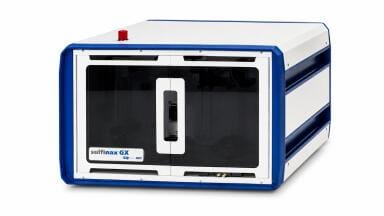
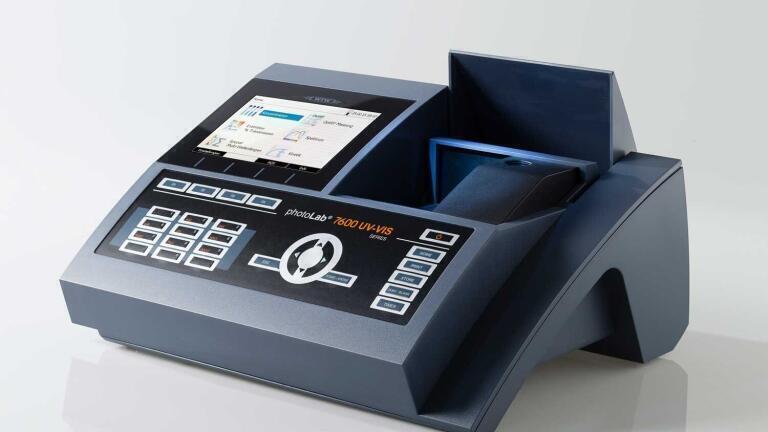
WTW have now successfully implemented the proven spectral measurement principle in the new photoLab® 7600 UV-VIS spectrophotometer, thus allowing to measure COD, nitrate and nitrite of effluent water without the need for any photometric reagent.
Performing an OptRF measurement is menu-guided and very simple:
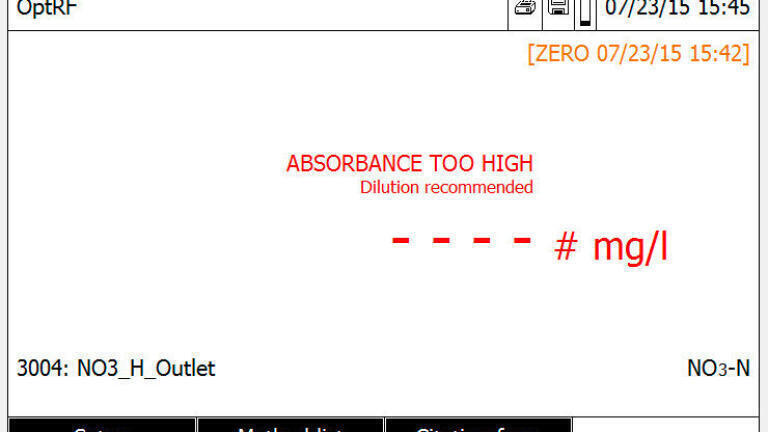
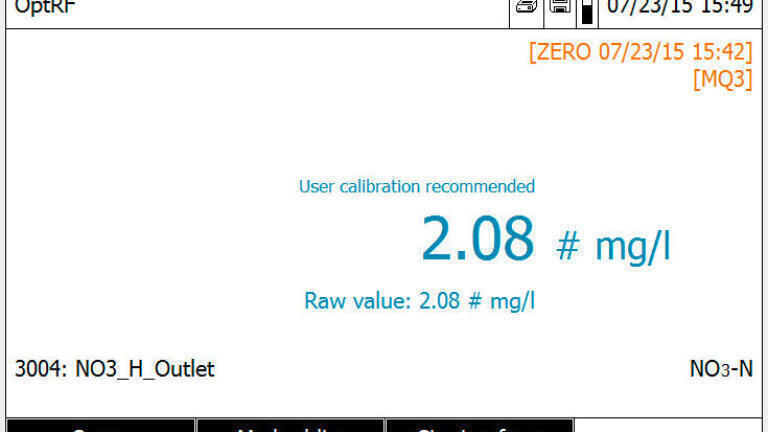
And the software assistance goes even further: If the concentration of the parameter is too high, the user is asked to dilute the sample, and if the measured spectrum differs substantially from the stored reference spectra, he is either asked to perform a calibration or warned of an unusable sample.
Sample composition is the decisive factor for the practicability of the OptRF measurement. Already the algorithms for the municipal effluents have been successfully used for some surface waters, however such an employment should be carefully checked before and verified regularly. Even though photometric test sets will remain indispensable for referencing and self-control, OptRF lends itself as a fast and cost-free option for quick daily monitoring, sample verification and preliminary tests of the expected measuring range.
IET 36.3 May

 Product directory