Water/wastewater
Published over 10 years ago. See the latest and most current information on Water/wastewater.
Process and plant engineers responsible for maintaining sanitary product, process and equipment environments will find the new panel mounted PA80 Peracetic Analyzer from US-Based Electro-Chemical Devices (ECD) simplifies process monitoring to ensure disinfection without the need for potentially harmful disinfection byproducts (DPBs).
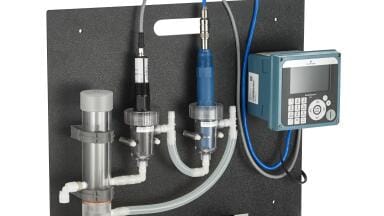
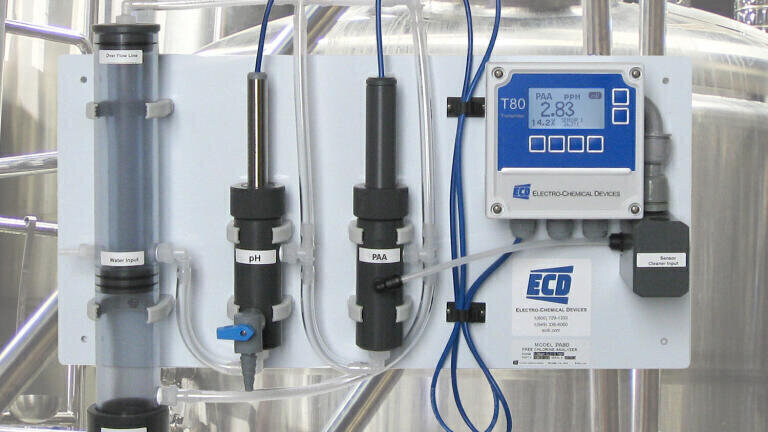
The plumb-and-play design of ECD’s economical PA80 Peracetic Acid Analyzer allows a single technician to install the unit right out of the box with no special tools or complex calibration routines. Ready to go from the factory, the PA80’s cost-effective design includes built-in flow control, and so there’s no need to purchase or install pressure regulators and rotameters, which are typically an extra cost with many other types of liquid analysers.
Peracetic acid is a colourless liquid with a characteristic pungent odour similar to vinegar.
PAA is produced by a reaction between hydrogen peroxide and acetic acid. Produced typically as an equilibrium solution combining these agents, PAA is supplied in concentrations of 5 to 15 percent. It is a powerful oxidiser, stronger than either chlorine or chlorine dioxide.
The rugged and reliable ECD PA80 Peracetic Analyzer features multiple PAA measurement ranges: 0-20, 0-200 and 0-2000 ppm. Providing multiple measurement ranges allows plant engineers to select the monitoring range that best fits the requirements of their product batch recipes, their processes and equipment cleaning requirements.
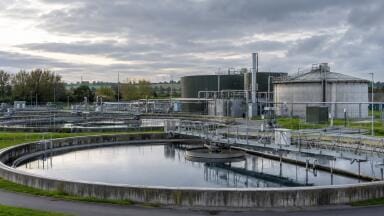
The food and beverage, medical and pharmaceutical industries all rely on PAA as a cleaner and sanitiser of process equipment, medical instruments and for bottle washing. It is also used as a disinfectant in municipal wastewater treatment and industrial cooling towers.
PAA is a highly effective bactericide that does not form any harmful disinfection by products (DBP) like many chlorine products do. It decomposes naturally into acetic acid and water and does not form a residual that has to be removed from the treated water.
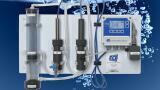
The PA80’s plumb and play design incorporates a constant head flow control device, a pH sensor, a peracetic acid sensor and ECD’s T80 analyzer/ transmitter—all conveniently mounted on a PVC panel. Plant technicians simply connect the sample and drain lines, connect the power and outputs, and the PA80 is ready to use. Calibration is accomplished by a grab sample comparison.
The PA80 Analyzer’s transmitter is 110-240 VAC or 24 VDC powered and allows either parameter to be graphically displayed with user defined line, bar or gauge style graphs. The standard configuration has two 4-20 mA outputs, three alarm relays and an industry standard MODBUS RTU (remote terminal unit).
Relying on precision amperometric PAA sensors that are flow sensitive, the PA80 provides accurate measurement with a minimum flow rate past the sensor of 0.5 ft/sec;
above this flow rate the output is virtually flow independent. The PA80’s constant head flow control device (CFD) maintains the optimum flow past the sensor over a wide range of incoming sample flow rates. The minimum flow required for the CFD is 10 gal/hr, and the maximum flow rate is 80 gal/hr with the sample draining at atmospheric pressure.
To reduce maintenance technician time and costs, the PA80 features an optional auto clean configuration, which includes a solenoid actuated spray cleaner that uses either 30 psi process water or air. An easily adjusted timer controls the period and duration of the cleaning cycle. The optional spray cleaner also eliminates fouling to protect batch sensitive products and prevent process line downtime.
IET Guide 2026

 Product directory