Ambient air quality
Published over 11 years ago. See the latest and most current information on Ambient air quality.
In the following article, Jim Mills, Managing Director of Air Monitors, provides an update on the performance of AQMesh, the wireless, low cost air quality monitoring pods that are now being installed all over the UK.
For decades, those responsible for monitoring ambient air quality have been frustrated by the capital and operational costs associated with installing and running the instrumentation that is necessary to be able to continuously measure air quality. This is because the instrumentation itself is expensive, mains powered, and large enough to even necessitate planning permission before installation. Such monitoring stations are able to provide highly accurate air quality monitoring data, but inevitably offer limited spatial distribution and require frequent service and calibration.
Traditionally, high quality data has only been available from expensive stations, and as a result, their numbers are relatively low, and this has created a necessity to rely on air quality modelling, which risks failure to identify the pollution hotspots that are such a threat to human health. Diffusion tubes have been employed in an attempt to plug these gaps, but they suffer from poor accuracy and simply provide an average figure over an extended period of time, which means that they miss pollution spikes. Low cost monitors have been available for many years, but they have been unable to measure accurately at the (ppb) levels required, so they have been largely unsuitable for most ambient monitoring purposes, until now that is…
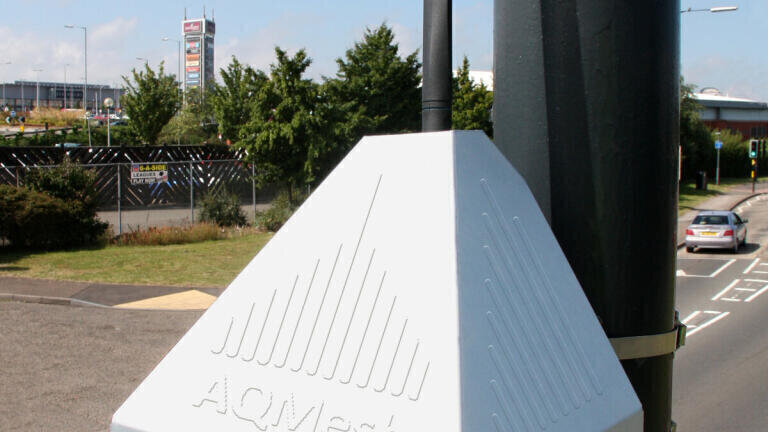
AQMesh
New low cost electrochemical sensors are now available for monitoring ambient gases at ppb levels. However, the major breakthrough that has been achieved by the developers of AQMesh, is the algorithm that is applied ‘in the cloud’ to the raw data provided by the AQMesh sensors. Since its launch over 2 years ago, AQMesh technology has been further refined to such an extent that the latest instruments are delivering monitoring data that track reference stations very closely.
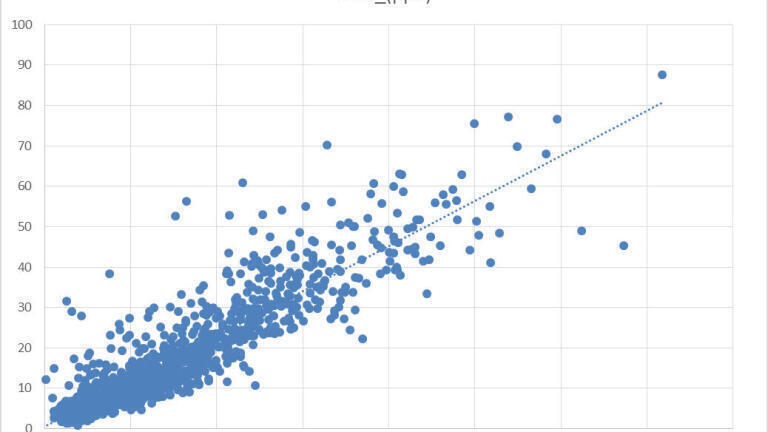
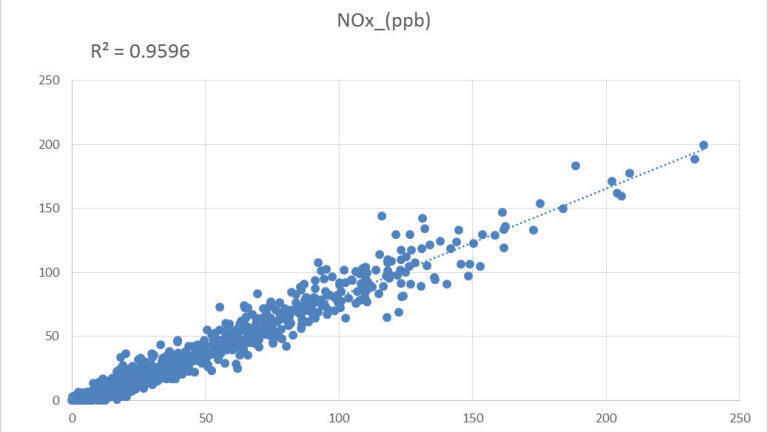
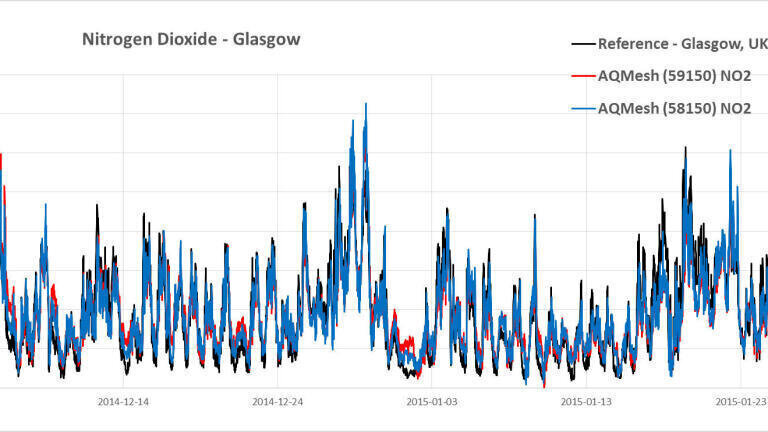
Before installation, it is common practice to run new AQMesh pods close to a reference station in the area that they will be deployed, and the data from this activity is nothing short of remarkable. For example, monitors deployed in June 2015 in the west of Scotland have shown R2 figures of 0.8348 for NO2 (Figure 1) and 0.9596 for NOx (Figure 2) when compared with reference monitors. Similarly, a trial in Glasgow ran two pods alongside a reference monitor as part of Transport Scotland's sensor rotation project, and again the NO2 readings followed the reference station very closely (Figure 3). A regression analysis showed R2 figures of 0.71 and 0.77 for the two pods against the reference station, and R2 was 0.96 when comparing the two pods with each other!
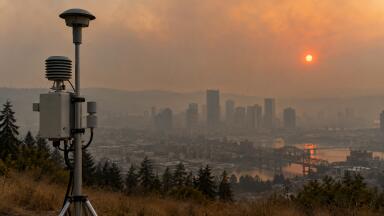
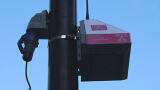
As small, wireless, battery powered units, AQMesh ‘pods’ are web-enabled, communicating cloud-based air quality data via the internet. Users are able to select the monitoring frequency (1–30 mins) and CO and/or SO2 is available in addition to the standard NO, NO2, O3, temperature, humidity and atmospheric pressure. Data can be viewed and downloaded from anywhere and battery life is typically up to 2 years.
The pods can be installed individually or as part of a network, on lamp posts, walls or fences in less than ten minutes, which means that air quality can now be measured accurately in the locations that matter most – close to schools, in traffic corridors, in congested areas, car parks, airports etc.
AQMesh offers an enormous opportunity to supplement existing monitoring networks without incurring high costs, whilst also providing the flexibility to monitor specific locations for shorter periods – for measuring the effects of highway improvements or construction projects for example.
IET 36.5 Sept/Oct 2026




 Product directory