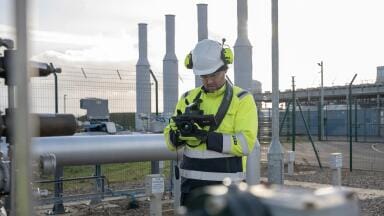
Air quality monitoring
Published over 11 years ago. See the latest and most current information on Air quality monitoring.
Have you ever found yourself short of breath on a particularly hot day? It might not just be the stifling heat or the stuffy humidity that’s causing you respiratory problems. Studies have shown that heatwaves can produce higher levels of pollution and reduced air quality.
Why? Essentially, the higher temperatures cause the sun’s rays to “cook” not only the air around us but also the chemical compounds which lie within it. These combine with the naturally-occurring nitrogen oxide (NOx) in the atmosphere to form ground-level ozone gas.
Inhalation of this invisible gas can agitate those with pre-existing respiratory conditions, cause the development of new conditions in those not previously susceptible and also cause complications for sufferers of heart problems.
Unsurprisingly, urban areas are the most affected by such pollution. The higher volume of people, cars and other vehicles, along with the narrower streets, make for a melting pot of pollution. Furthermore, industrial sites such as power plants can cause a huge amount of harmful emissions, which are only exacerbated on hot days.
This is not to say that the countryside is exempt, however. The effects of car exhaust fumes and industrialisation can still be felt in far-flung regions of the country, while pesticides and fertilisers can contribute pollutants that aren’t found in cities. This can result in detrimental effects not only on the human populace, but also on the diversity of flora and fauna in the region. For more information on the topic, check out the interesting article UK Countryside in Danger Due to Air Pollution.
Over recent years, the UK has enjoyed (or suffered, depending on which way you look at it) unprecedented heatwaves. A recent 2013 conducted by the Stockholm Environment Institute found that in 2006, a particularly strong heatwave caused the death of up to 460 people indirectly through ozone pollution. Indeed, across the pond in the United States, the same heatwave caused 38 of 50 states to report more polluted air than was found in the same month of the previous year.
This year, we have already had what is predicted to be possibly the hottest day of 2015. On the first day of July, temperatures climbed as high as 33°C in some parts of Britain, which caused Friends of the Earth Scotland to predict that air quality safety levels would be exceeded in up to 31 different councils.
While we might not be able to control the temperature outside (at least, not in the short term), we can combat the pollution found in our air. The article Improving Air Quality and Reducing Transport-Related Pollution goes into detail about how both industry and private individuals can do their bit to reduce their carbon footprint, looking in particular at alternative fuel sources.
In terms of counteracting the effects of ozone pollution on a personal level, however, people are encouraged to:
IET Guide 2026

 Product directory