Air monitoring
Approach Temperature might not be the most glamorous parameter in a circulating dry scrubber, but it is one of the most important. Get it wrong, and the consequences show up quickly, either in reduced SO₂ capture or in corrosion problems further downstream. The challenge, as many operators know, is that it has always been easier to talk about than to measure with any real confidence.
Run the system too hot, and hydrated lime efficiency drops off, limiting the effectiveness of SO₂ removal. Push too close to saturation, and the risk flips, with acid condensation leading to corrosion in ductwork and equipment. The “sweet spot” sits somewhere in between, but finding and holding that position has traditionally relied on indirect indicators and a fair amount of experience.
At the heart of the issue is how Approach Temperature is defined. In theory, it’s linked to the adiabatic saturation temperature (AAST) approach, but that’s not something you can easily measure in a live process. So, in practice, operators have leaned on acid dewpoint as a stand-in, thanks to a reasonably well-established correlation between the two.
But even that may not tell the full story. Recent work suggests that the conventional understanding of dewpoint, which assumes condensation begins only at equilibrium saturation, may be too simplistic. Condensation can start earlier, at the very first stage of liquid formation. That subtle shift in definition matters because it’s that initial onset that often dictates when corrosion and deposits begin to form.
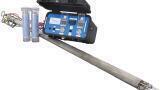
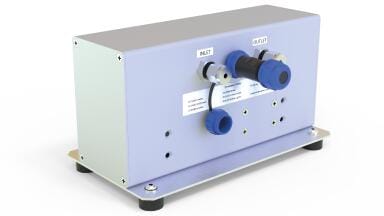
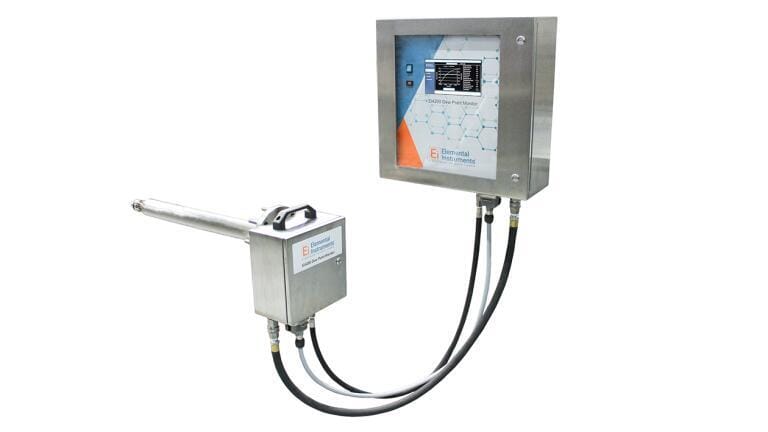
To see what was really happening inside an operating system, Ohio Lumex put its Ei4200 Dewpoint Monitor to the test in a circulating dry scrubber. Installed directly in the duct between the reactor and the baghouse, the instrument ran continuously over several weeks, measuring acid dewpoint under real process conditions.
What makes this system different is its sensitivity. Rather than waiting for obvious condensation, it detects the earliest traces by monitoring tiny changes in electrical current as acid begins to form on a glass sensor. It’s a small signal, but one that turns out to be very revealing.
In practice, the monitor performed well. It handled the harsh environment without issue, stayed clean, and produced data that matched expected process behaviour. More interestingly, by analysing how sensor temperature related to changes in current, it became possible to pinpoint the actual temperature at which condensation begins—not just the traditional “dewpoint” value.
The data also highlighted just how dynamic Approach Temperature really is. Changes in SO₂ loading, water injection, and hydrated lime feed all had clear, measurable effects. Increasing water flow tended to lower dewpoint under steady conditions, while higher SO₂ levels generally raised it. None of this will surprise experienced operators—but seeing it quantified in real time adds a new level of clarity.
The broader takeaway is straightforward. Instead of relying on approximations, it is now possible to measure what actually matters: the true onset of acid condensation. That, in turn, gives operators greater confidence to operate closer to optimal conditions—improving SO₂ removal, reducing corrosion risk, and making better use of reagents.
It is not a dramatic shift, but it is important. And in a process where margins are tight and reliability is everything, having a clearer picture of what’s really happening inside the duct can make all the difference.
For those who want to explore the details behind the findings, the full paper Direct Measurement of Approach Temperature in a Circulating Dry Scrubber is available from the authors.
IET Guide 2026

 Product directory



















.jpg)