Air monitoring
Published over 16 years ago. See the latest and most current information on Air monitoring.
The demands the automobile industry places on hydrogen detectors are scarcely realisable: they have to be H2-specific, exact, durable and robust, have short response times and in addition low power consumption. They are also expected to compensate for temperature fluctuations and humidity.
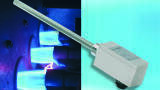
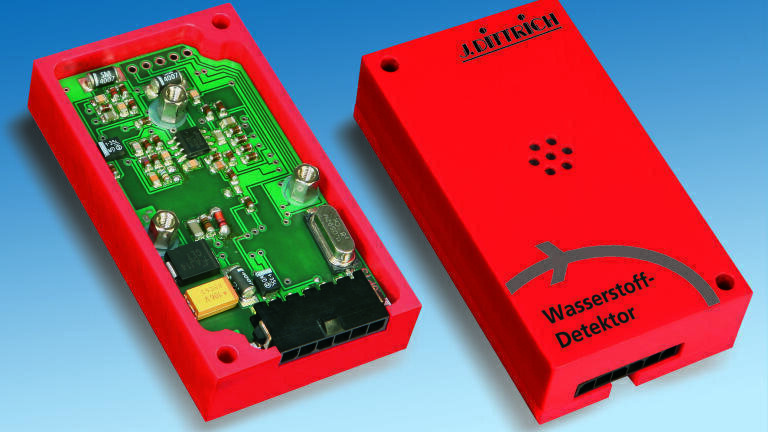
Now J. Dittrich Elektronic (Germany) is launching a hydrogen detector on the market that is capable of meeting these demands, using a novel electrochemical solid electrolyte sensor. Contrary to an electrochemical cell, the sensor contains a solid electrolyte instead of a liquid electrolyte.
At the three-phase boundary of the measuring electrode the hydrogen splits into protons and electrons; the resulting current flow is proportional to the hydrogen concentration. Since this reaction takes place at room temperature, the heating systems required for classic solid electrolyte sensors are not needed. The power input of this handily sized detector (L65 x W36 x H16 mm) is correspondingly low at 0.32 watts. It contains no moving parts; silicone, halogen and sulphuric compounds do not impair its functioning. In addition, it is neither cross sensitive to HC, H2S, NO, NO2, CO nor to CO2.
The sensor has a fast response time, a long service life (approx. 40,000 operating hours) and is operational within a temperature range of -20 to +80° C and at a relative humidity of 5 to 90% RH. The measuring range is linear from 0.01 to 4 vol%. The intelligent electronics process the measured values, output the measuring signal, monitor the functioning of the system and report any faults.
The newly developed hydrogen detector with solid electrolyte sensor is H2-specific, durable and robust. It improves fuel cell reliability and thereby its acceptability to customers.
IET 36.5 Sept/Oct 2026



 Product directory