Air monitoring
It supports everything from urban air quality studies to emissions mapping and remote sensing campaigns.
However, conventional systems still face a structural constraint: instruments are typically optimised either for high-precision, narrow-field scanning or for fast, wide-area snapshot imaging.
The result is an operational trade-off between accuracy, efficiency, field of view, and size.
A new mechanically reconfigurable metasurface LiDAR developed by researchers at Tsinghua University offers a route out of this limitation by combining scanning and flash LiDAR into a single tunable platform designed for adaptive 3D sensing.
For air quality and emissions monitoring, the implications are significant.
At the core of the system is a dual-mode beam-forming device built from cascaded metasurfaces and a shape-memory alloy micro-actuator.
The metasurfaces perform the optical phase control necessary to switch between two operating modes: a high-resolution beam array scanning mode and a single-shot flash illumination mode.
The actuator enables precise lateral translation (on the order of ±100 micrometres) allowing dynamic modulation of the outgoing beam array.
By using incident circular polarisation to select the operating mode, the device can toggle between detailed scanning and wide-field illumination without bulky mechanical components.
The resulting LiDAR achieves a combination of characteristics that standard systems struggle to deliver simultaneously: high spatial resolution, extended detection range, rapid snapshot imaging, wide field of view, and compact form factor.
These features align closely with the demands of modern field-based environmental monitoring, where instruments must be lightweight enough for UAVs, responsive enough for mobile platforms, and capable of both rapid area scans and precise follow-up sampling.
The system’s dual-mode operation is particularly useful for air quality and emissions applications.
In flash mode, the LiDAR performs a wide-area snapshot scan of the scene.
This provides immediate, coarse 3D context: terrain, building geometry, vegetation structure, and plume morphology.
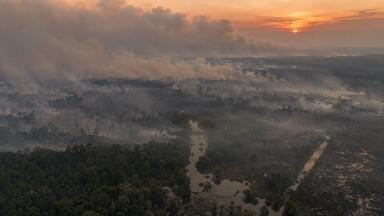
Capturing this context in a single exposure is valuable for airborne monitoring of dust, smoke, or chemical releases, where plume geometry shifts quickly and operators need a fast situational overview.
This initial snapshot also enables adaptive sensing.
The software uses the flash-mode 3D point cloud to identify edges, structures, or regions of interest.
It then switches into scanning mode, where the system performs fine or coarse scanning depending on the needs of the target.
In fine mode, with 10-micrometre translation steps, the angular resolution reaches roughly 0.3°, allowing high-precision reconstruction of objects or surfaces.
For environmental monitoring, this allows a single instrument to map the broad shape of an emissions plume and then zoom into features such as stack geometry, leak points, or surfaces where particulate deposition occurs.
In addition, the system provides a field of view of approximately ±35°, which improves efficiency for drone-mounted surveys or mobile monitoring routes in complex environments.
For urban air quality mapping, this enables more complete coverage around buildings and within street canyons, where conventional LiDAR often struggles to resolve geometry quickly enough to support dispersion modelling.
Better 3D context data ultimately improves interpretation of co-located gas and particulate measurements.
Miniaturisation is another important advantage.
Traditional LiDAR designs rely on rotating mirrors or bulk optical assemblies, which add mass and limit portability.
Metasurfaces, flat optical elements engineered at the nanoscale, provide the necessary phase manipulation using a single ultrathin layer.
Integrating two metasurfaces with a micro-actuator produces a beam-forming device that is both compact and multifunctional.
For environmental monitoring, reduced size and weight open new deployment pathways.
UAVs for emissions surveillance at industrial sites, handheld devices for rapid surveys around construction or waste facilities, and autonomous ground robots for confined space inspections.
The system’s versatility also pairs well with other optical techniques used in air quality and emissions monitoring.
LiDAR is not itself a gas-specific analyser, but it supports complementary methods by providing the spatial structure of the measurement scene.
This becomes particularly relevant for techniques such as differential absorption LiDAR (DIAL), fluorescence-based aerosol profiling, or backscatter analysis for dust.
The metasurface LiDAR’s ability to switch between fast, whole-scene scans and targeted, high-resolution scanning makes it well suited as a supporting instrument for platforms carrying spectroscopic gas sensors, particulate monitors or hyperspectral imagers.
For ground-based emissions work, the technology can assist leak detection and repair (LDAR) workflows by offering real-time 3D mapping of equipment layouts.
Unlike gas detection cameras or point sensors, which provide concentration data but limited geometric context, LiDAR supplies a structural model of the environment against which plume paths, thermal imaging, or infrared absorption data can be interpreted.
Adaptive scanning reduces time on site, especially when inspecting multiple assets such as tanks, flanges, or pipelines.
The researchers emphasise that their approach is compatible with a range of detection mechanisms, including time-of-flight and binocular vision techniques.
This means the beam-forming device can be integrated into existing LiDAR architectures without redesigning core electronics or timing systems.
The flexibility will likely make the technology attractive to manufacturers exploring next-generation compact or UAV-ready LiDAR units aimed at environmental monitoring markets.
As environmental monitoring shifts toward higher-frequency, higher-spatial-resolution data collection, driven by UAV surveys, urban micro-monitoring, and tighter emissions requirements, the need for adaptable, lightweight, and precise 3D sensing tools continues to grow.
Mechanically reconfigurable metasurface LiDAR provides a promising foundation for such systems.
By collapsing scanning and flash LiDAR into a single reconfigurable module, it offers a pathway to faster scene analysis, more efficient fieldwork, and better integration with the wider suite of optical and atmospheric sensors now used across air quality and emissions monitoring operations.
IET 36.5 Sept/Oct 2026

 Product directory