Water monitoring
Now it no longer does.
A study published this spring in Science Advances presents two decades of direct instrumental measurements from four deep-ocean monitoring sites along the western Atlantic, and the signal is unambiguous: the AMOC is weakening.
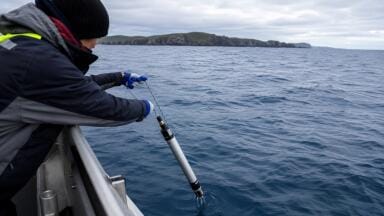
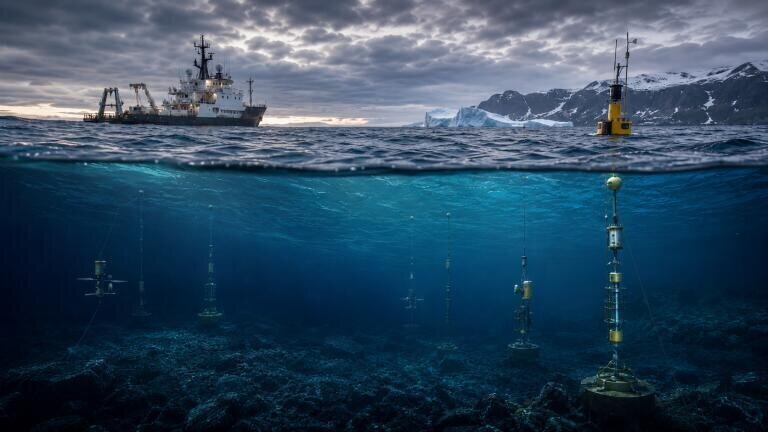
The instruments doing the watching are anchored to the seafloor, measuring pressure, temperature, water density and current velocity in near-continuous streams of data.
Changes in bottom pressure are used to estimate the movement of deep water masses below roughly 1,000 metres – the cold, dense return flow that completes the overturning cycle.
It is expensive, technically demanding science. And as researchers and policymakers are now urgently pointing out, it is dangerously underfunded.

The AMOC observing network grew organically from academic research projects – most notably the RAPID array, which has operated across the 26°N latitude line since 2004, and OSNAP (Overturning in the Subpolar North Atlantic Programme), which covers higher latitudes.
Both programmes have produced invaluable data. Both operate on short-term competitive grants.
A new report from the Nordic Council of Ministers, published in early 2026, sets out the problem in stark terms.
The AMOC observing system, it warns, is "at the brink of collapse" because of under-funding.
Researchers are caught in a structural trap: maintaining a long-term observational record requires continuous, decade-scale commitment yet the dominant funding mechanism – competitive academic grants, typically three to five years in duration – is entirely mismatched to that need.
Add to this the growing political instability surrounding US federal climate spending, on which several transatlantic programmes partially depend, and the vulnerability becomes acute.
The scientific case for watching the AMOC is well established.
A weakening circulation reduces heat transport to western Europe, disrupts rainfall patterns across the Sahel and Amazonia, raises sea levels on the US eastern seaboard, and alters the productivity of North Atlantic fisheries.
Modelling published alongside the Science Advances paper projects an approximately 50 per cent weakening by the end of this century under current trajectories – a finding that, if confirmed by continued measurement, has profound implications for European infrastructure, agriculture and energy planning.
Iceland and Finland have already incorporated potential AMOC tipping into their national security and economic risk frameworks.
The Nordic report recommends that other governments follow suit and critically, that AMOC monitoring be formally reclassified from "research activity" to "critical infrastructure", on a par with meteorological observation networks.

The timing is significant. The EU Ocean Act, moving through Brussels in 2026, provides a legislative vehicle for exactly the kind of coordinated, treaty-backed observational commitment that scientists are requesting.
The Horizon Europe 10th Framework Programme represents another opportunity to ring-fence funding specifically for sustained ocean observation, rather than routing it through the same competitive grant system that has left RAPID and OSNAP exposed.
The Nordic report recommends a two-track approach: secure backstop national funding for the 2026–2028 transition period to cover any gaps caused by US withdrawal or grant lapses, and pursue formal designation of AMOC monitoring assets as critical national infrastructure within Nordic and EU frameworks.
An early warning system – coupling continuous Earth observations with ensemble climate modelling – is proposed as the practical output of this investment, one capable of feeding directly into policy response timelines.
Scientists estimate that 30 to 40 years of continuous, high-quality measurements will be needed to definitively characterise the long-term AMOC trend against the backdrop of natural variability.
That is a commitment – and one that, for much of western Europe, is a matter of climate security rather than scientific curiosity.
IET Guide 2026

 Product directory