River water monitoring
Published over 16 years ago. See the latest and most current information on River water monitoring.
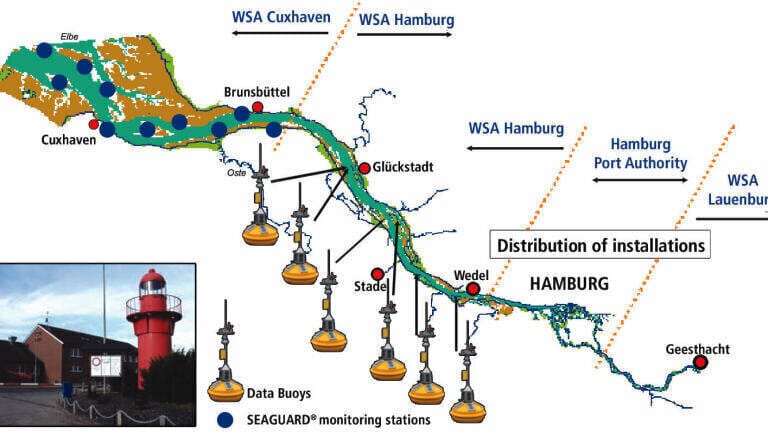
End of last year AADI’s (Norway) German distributor Nautilus Marine Service GmbH was awarded a contract by the German Waterway and Shipping Administration (WSV) to modernize their network of hydrological monitoring stations along the river Elbe. The upgrade comprises 7 AADI Data Buoys and 10 river pile stations as well as the delivery of up to 130 SEAGUARD®.
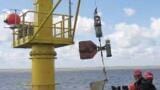
The data buoys are fitted with a SEAGUARD® RCM (Recording Current Meter) including a series of sensors just below the buoy in order to monitor water flow (speed, direction), temperature, salinity, turbidity and oxygen. A second, identical configured SEAGUARD® RCM is installed at approx. one meter above the river bed in a bottom frame and linked with the data buoy by a special data and lifting cable. Data from both SEAGUARD® s are stored and can be transmitted in real-time from the buoy into the network of the WSV.
The setup for the pile based stations is similar. Here the same parameters as for the buoys will be measured approximately 2 meters and 4 meters above the river bed and send out in real-time as well.
In addition to the acquisition of hydrological standard parameters along the river Elbe to fulfil their duties in terms of administration and the provision of safety for the federal waterway Elbe and adjacent territorial waters, the scientific focus has put back on the basic transport processes of sediments, suspended material and the morphological behaviour of the bottom zone of the tidal river Elbe and their natural and anthropogenic influences.
Observed rising dredging amounts at the Elbe estuary over the last years due to greatly increased dredging activities of the Hamburg Port Authority and an upstream shift of dredging areas of the WSV towards Hamburg during the same time period require more dredging capacities and subsequently more ecological tests have to be carried out to give real-time input to live data models predicting the transport of sediments into the shipping channels.
IET Guide 2026

 Product directory

















.jpg)