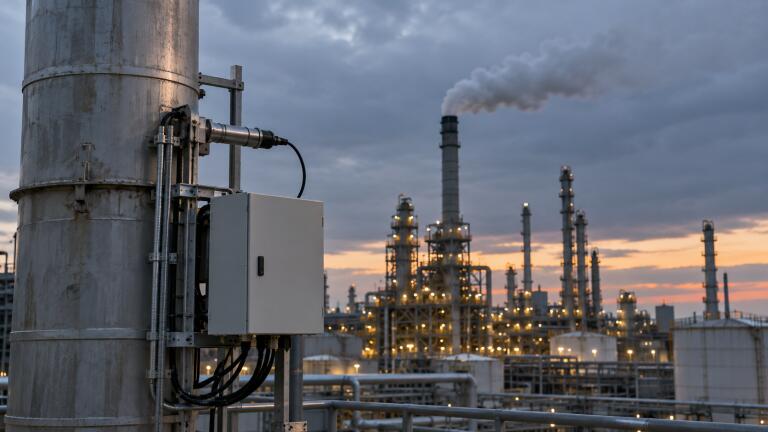
CEMS
The Central Pollution Control Board (CPCB) first mandated installation of continuous emission and effluent monitoring systems (CEMS/OCEMS) across 17 categories of highly polluting industries in 2014, with detailed guidelines issued in August 2017 and revised in August 2018.
For refinery labs, the obligation to monitor stack emissions in real time and transmit the data to CPCB and State Pollution Control Board (SPCB) servers has been in force for over a decade.
What has changed is not the mandate itself but how seriously CPCB is now enforcing the quality of the data it receives.

The installation numbers tell part of the story. Across the 17 mandated categories nationally, roughly 4,200 units were targeted for OCEMS installation.
The large majority have been installed and connected, though a meaningful minority have received closure directions for non-compliance.
Sectors including chloralkali, copper and refining are reported to have fully installed their targeted units with no closure directions outstanding.
Refineries, in other words, are among the better-compliant sectors on installation, which shifts the practical compliance question from hardware to data quality.
That second question is where CPCB has been tightening its grip.
A revised OCEMS calibration protocol, effective from July 2025, introduced quarterly calibration for gaseous emission analysers, quarterly calibration checks for particulate matter monitoring systems, and annual performance testing by accredited laboratories for both – a significantly more demanding cadence than periodic testing regimes typically require.
In parallel, CPCB designated CSIR-National Physical Laboratory (CSIR-NPL) as the national verification and certification agency for CEMS equipment, meaning instruments already certified by bodies such as MCERTS or the US EPA still require separate CSIR-NPL verification before they satisfy Indian requirements – a certification step that adds lead time to instrument procurement and replacement.
A further directive in September 2025 pushed compliance obligations beyond the instruments themselves and into the surrounding data infrastructure.
Industries in the 17 mandated categories, along with NCR-Delhi units, were directed to register on a new OCEMS/ODAMS portal, map monitoring stations by GPS coordinate, maintain updated analyser inventories and enable direct real-time telemetry to CPCB servers – removing reliance on third-party data transmission and tightening the audit trail between what a refinery's stack is emitting and what the regulator sees.
The same directive introduced requirements for PTZ camera integration at monitoring stations and strengthened automated alert generation for excursions.
Taken together, these changes reframe what CEMS compliance means for a refinery lab in 2026.
Under the original 2014-18 framework, installing certified hardware and submitting periodic data was largely sufficient.
Under the current calibration and telemetry regime, a refinery must additionally maintain a quarterly calibration cycle with accredited third-party verification, hold CSIR-NPL-certified instrumentation regardless of prior international certification, and run a live, geotagged, camera-monitored data feed direct to CPCB.

The underlying rationale, as CPCB and independent guidance both put it, being that installation alone does not ensure compliance, and that periodic monitoring has historically failed to catch excursions that continuous, verified telemetry is designed to surface.
For refinery lab managers, the practical gap to watch is between systems that were installed to the 2018 guidelines and never revisited, and the calibration, certification and telemetry standard now being enforced.
A CEMS installation that satisfied CPCB in 2019 will not necessarily satisfy the verification, calibration frequency, or data-transmission requirements introduced since mid-2025 – closing that gap is now the substance of compliance, not the original installation mandate.
IET 36.5 Sept/Oct 2026


 Product directory




.jpg)













.jpg)





.jpg)
.jpg)