Air monitoring
As emission limits tighten, CO measuring ranges shrink to a few ppm. At that level, the heated sample line itself can become a CO source. The new TBX-H PerfectZero from AGT-PSG uses a metallic diffusion barrier to keep the sample path clean, even at 200 °C.
Continuous emission monitoring systems (CEMS) and process analysers increasingly work with low CO measuring ranges. Modern combustion and abatement technologies produce cleaner flue gas, and permits demand lower limits. The analyser is usually well characterised. The sample path between probe and analyser is often not.
In extractive gas analysis, the sample must stay above its water and acid dew point all the way to the cooler or analyser. Otherwise, condensate forms, acids attack components and water-soluble species such as SO₂, NH₃ or HCl are lost. In sulphur-containing flue gases the acid dew point can reach about 150–155 °C. Holding temperatures of around 180 °C are therefore common, and some applications require up to 200 °C.
At these temperatures, materials in the heating cable and insulation can release CO. PTFE and PFA tubes are chemically resistant and have low surface interaction, which makes them the standard sample tube material. However, they are not fully gas-tight: gases can permeate through the tube wall into the sample stream. In high measuring ranges the effect is negligible. In ranges of a few ppm, it can produce a systematic positive offset. The operator then partly measures the line, not the process.
Operators can check whether their line contributes CO. With probe and line at operating temperature, zero gas is first applied directly at the analyser and then via the test gas connection at the probe, so that it passes through the entire heated line. If the CO reading is higher via the full path, the line is adding CO.
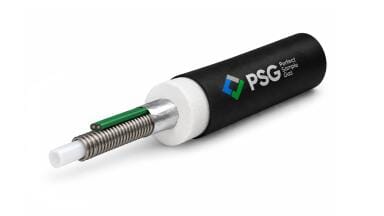
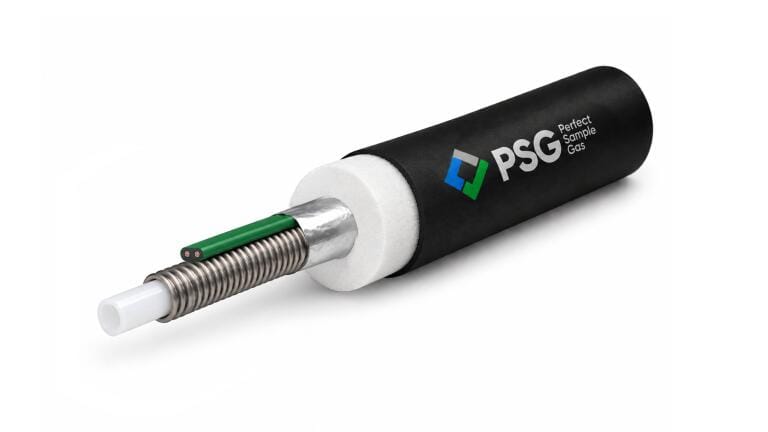
One remedy is to separate the sample tube physically from the heater and insulation. In the TBX-H PerfectZero heated sample line, a flexible stainless-steel corrugated tube surrounds the PTFE or PFA sample tube and acts as a diffusion barrier. The sample tube retains its chemical advantages, while gases released by the heated components can no longer reach the sample stream. Because the corrugated tube is flexible, the TBX-H PerfectZero still allows bending radii of 4–5 times the outer diameter and holding temperatures of up to 200 °C.
Beyond the barrier, the TBX-H PerfectZero is designed as a modular platform that covers further practical requirements:
At low CO ranges, measurement quality depends on the whole sample path. Operators should test their existing lines with zero gas and specify a line with a metallic diffusion barrier, such as the TBX-H PerfectZero, for new installations where holding temperatures are high and CO ranges are low.
AGT-PSG offers this design as TBX-H PerfectZero: holding temperature up to 200 °C, replaceable PTFE/PFA tube, up to 450 m in one length, standard versions from stock.
For further insights into AGT-PSG's process analytics solutions, read this related article, Smarter flare gas monitoring starts with smarter process analytics.
IET 36.5 Sept/Oct 2026

 Product directory