Water/wastewater
Published over 16 years ago. See the latest and most current information on Water/wastewater.
Dionex announces two recently approved methods for the determination of disinfection by products in drinking waters.
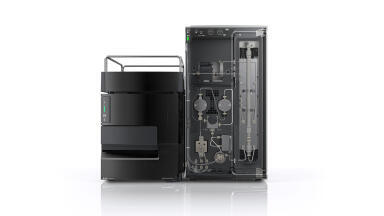
Method 302 is a two-dimensional (2-D) IC method that was developed to provide a more robust solution for drinking waters with high concentrations of anions compared to the post column method 317 and 326. Using a Reagent-Free™ IC (RFIC™) system, EPA 302.0 allows the user to just add water to each system instead of preparing eluents and unstable or toxic post-column reagents. EPA 302 uses a 2-D system setup.
1) the first system partially resolves the matrix, andremoves and traps a time segment containing bromate, and
2) reruns this time segment on a second system. Both systems only require the addition of distilled water. This method can be performed using two IC systems, or a dual ICS-3000 system. Method 302 is suitable for all waters which are regulated for bromate compliance monitoring.
EPA 557 is an alternative to methods 552.1, -.2, and -.3, which use GC/ECD based detection. The 552 methods require extensive sample preparation—laborious extraction, 2 hr. derivatization, and pH adjustment; pretreatment that can take up to 3-4 hours per sample. Alternatively, 557 is a direct injection technique with no sample preparation that uses an RFIC system and hydroxide eluent for ion-exchange separation prior to MS/MS detection. The newly developed IonPac® AS24 column provides complete chromatographic resolution for each analyte, even in high-ionic-strength waters. This allows diversion of suppression-causing anions to waste prior to entering the ESI source for exceptional sensitivity and detection.
IET Guide 2026

 Product directory