TLC Meter “How-To” Video: Two-Point User Calibration

Water/wastewater

TLC Meter “How-To” Video: Two-Point User Calibration

24 Sep, 2012

Published over 13 years ago. See the latest and most current information on Water/wastewater.

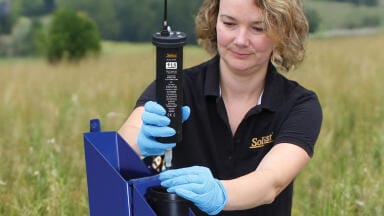
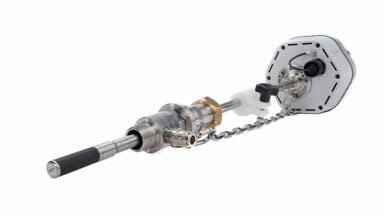
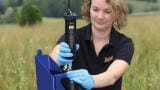
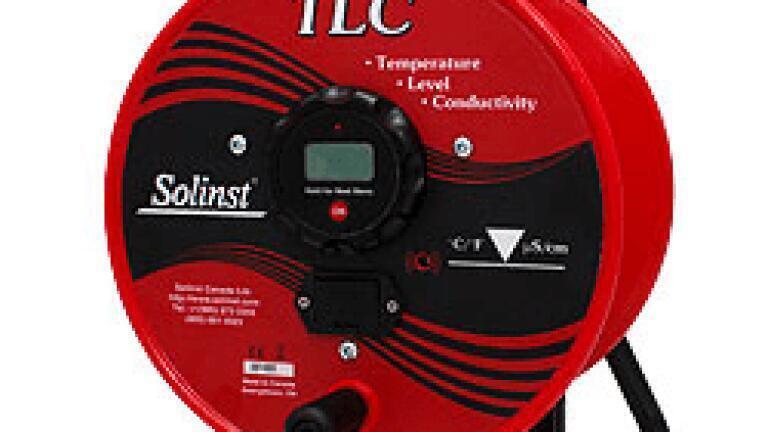
A Solinst TLC Meter measures water level, temperature, and conductivity. To ensure accuracy of readings, the user can easily calibrate the Meter for conductivity, as required. User calibration allows for adjustment of a TLC Meter if the probe has been altered slightly due to mechanical, biological or chemical affects. If a TLC Meter is tested in standard calibration solution, and the readings are outside the 5% accuracy range, the user can conduct a manual calibration at 1, 2, 3, or 4 separate conductivity levels, using standard solutions (1413, 5000, 12,880, or 80,000 µS/cm). To simplify the process further, Solinst has released a practical video that takes the user through the process of a two-point calibration.

For more information about the Solinst Model 107 TLC Meter, Click HERE>>

Notes:

  1. The de-ionized water, calibration solutions and the probe should all be at room temperature when conducting the calibration.
  2. Calibrate only with 1413, 5000, 12,880 and 80,000 μS/cm solutions. Calibrating with other solutions will cause errors.
  3. Clean probe thoroughly before each calibration step by rinsing in de-ionized water until the conductivity reading reaches ~ 20 μS or less.
  4. Do not let the probe rest on the bottom of the cylinder.
  5. Always ensure that no bubbles are trapped inside the probe shroud. Air bubbles will result in inaccurate calibrations.
     

IET 36.2 Mar/Apr 2026

Explore our Digital Edition

Discover the latest news and research

Digital edition

Explore Our Other Sites

Labmate Online
Fast gas analysis, wherever the work happens
Explore more Arrow
Pollution Solutions Online
University of Edinburgh licences breakthrough e-waste gold and copper recovery technology to lithium universe
Explore more Arrow
Petro Online
Free webinar: enhancing accuracy and efficiency in renewable fuel laboratory testing
Explore more Arrow
Chromatography Today
Chromatography and XFEL imaging reveal critical point behind water’s behaviour
Explore more Arrow