Water/wastewater
Published over 13 years ago. See the latest and most current information on Water/wastewater.
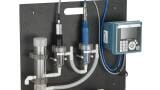
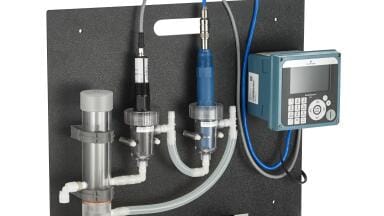
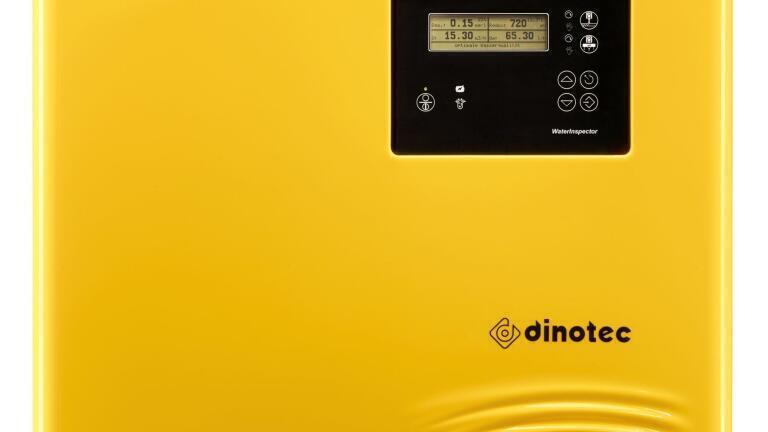
An electrolytic cleaning process has been used for many years for cleaning metal surfaces prior to galvanic refining processes. The new automatic electrode cleaning "AER" developed by dinotec Water Technology (Germany) makes use of this proven electrolytic process in a greatly improved form, offering the user new benefits.
A thorough cleaning of the electrode surface with this process is unfortunately accompanied by an unintended, strong polarisation of the electrode. The disadvantage is that, after the cleaning and depending on the water quality, there is a certain time lag before the correct measured value is reset. It can take an hour or longer until a correct measurement signal is available. The computation algorithms used for an error correction in this case often fail to achieve the desired result.
With the new "AER" electrode cleaning process, dinotec Water Technology ensure that a reliable measurement signal is available within a short time without requiring a mathematical correction. In addition, the "AER" system automatically tests the measurement system for a correct function after the actual cleaning process (duration <10 s). This means additional safety for the operator.
Professionals are particularly impressed that measuring systems with the new "AER" automatic electrode cleaning even work in salt water. No special sensors are required in this case.
The new "AER" offers considerable advantages compared to a mechanical cleaning of electrodes: The polarising layer necessary for measurement is not adversely affected. As a result, there is no zero point error in the measurement. This proves to be an advantage especially with small measured values; The "running-in period" of the measurement is short. Contrary to conventional systems with mechanical cleaning, the measurement system must not be recalibrated; There are no new running-in periods, such as after an interruption of the mechanical cleaning e.g. due to a lack of sample water; The measurement accuracy is independent of the consistency of the sample water quantity and the resulting reproducibility; Unlike conventional processes, the electrode is wear-free.
Compared with a mechanical cleaning of the electrode with sand or glass beads, the new automatic electrode cleaning "AER" thus provides remarkable benefits.
Christoph Scheffold, product manager and developer of the AER, "We have been testing the AER for months, even in problematic applications. The results have been consistently positive and experts have been impressed."
IET Guide 2026

 Product directory