Health & safety
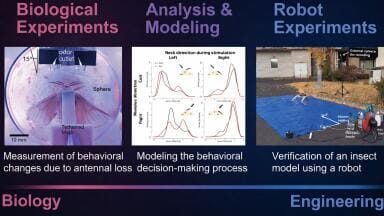
Researchers in Japan have demonstrated a robotic system modelled on the behaviour of the Bombyx mori that can continue to locate an odour source even after losing one of its two 'antennae' sensors.
Rather than relying on symmetrical sensor input – a common assumption in many existing systems – the robot adapts its movement strategy dynamically, using partial data to maintain directionality towards the source.
The work, published in npj Robotics, reframes odour localisation as a resilience problem as much as a sensing one.
For health and safety professionals, this technology can conquer environments where conventional detection approaches struggle: post-incident sites, confined or structurally unstable spaces, or outdoor releases where wind disrupts plume behaviour.
In such scenarios, the challenge is not just detecting the presence of a hazardous gas but tracking its origin under degraded conditions. The researchers showed that their insect-inspired control algorithm allows the robot to maintain comparable localisation performance even when one sensor is disabled, both indoors and in more complex outdoor settings.
This suggests a pathway towards mobile systems that remain operational despite partial failure – a key requirement in high-risk deployments where redundancy is critical but not always guaranteed.
This has clear implications for incident response workflows. In many industrial settings, once a leak or release is detected, the next step is often manual: technicians equipped with portable detectors or imaging tools attempt to locate the source.
That process can be hazardous and dependent on operator experience, particularly in low-visibility or high-risk conditions. A mobile robotic system capable of autonomously navigating towards a gas source – and crucially, continuing to function despite partial sensor failure – could reduce exposure risks and shorten response times.
In disaster scenarios such as explosions, chemical spills, or infrastructure collapse, where sensor damage is likely, this kind of robustness becomes even more valuable. The underlying biological insight is that silkworm moths do not depend on perfect bilateral sensing. Instead, they integrate intermittent odour detection with their own movement and orientation, switching between behavioural modes depending on whether they are currently in plume or not.
By translating this into an engineering framework, the team created a system that compensates for missing spatial information rather than attempting to reconstruct it.
This is a notable departure from many algorithmic approaches to gas source localisation, which typically assume stable gradients or rely on dual-sensor comparison for directional cues. In turbulent, real-world environments – where gas plumes fragment and disperse unpredictably – that assumption often breaks down.
Gas detection systems deployed in industrial environments are exposed to mechanical stress, contamination, weathering, and calibration drift. While fixed systems are typically designed with redundancy and maintenance schedules in mind, mobile or distributed systems operating in the field face a higher likelihood of partial failure.
A navigation and localisation framework that can tolerate asymmetric sensor performance – rather than shutting down or producing unreliable outputs – aligns with the growing emphasis on fail-operational design in safety-critical systems.
In practical terms, such systems are unlikely to replace fixed or portable gas detectors used for compliance monitoring, exposure assessment, or process control.
Those applications require quantification, selectivity, and certification that go beyond the scope of this research.
However, there is a clear complementary role in search and localisation tasks, particularly where human access is unsafe or where conditions are too dynamic for static monitoring to be effective. Mobile robotic platforms equipped with robust navigation strategies could be deployed to identify leak sources or support emergency response teams in real time, feeding actionable intelligence back to control rooms or incident commanders.
The broader implication for instrumentation users is a shift towards resilient, system-level design in gas detection workflows.
Rather than focusing solely on sensor accuracy or sensitivity, there is increasing value in architectures that can tolerate failure, adapt to uncertainty, and continue to deliver actionable information under real-world constraints. This aligns with parallel developments in industrial automation, where edge intelligence, redundancy, and adaptive control are becoming standard expectations rather than advanced features.
As industrial sites become more automated and as safety expectations tighten, the integration of mobile, intelligent detection systems is likely to accelerate. This work does not yet represent a deployable solution, but it highlights a direction of travel: from precise measurement alone towards adaptive, fault-tolerant detection ecosystems that can operate where conventional systems reach their limits.
For health and safety professionals, the key takeaway is not just the novelty of insect-inspired robotics, but the emerging importance of systems that can continue to function – and continue to protect – when conditions are at their worst.
IET 36.5 Sept/Oct 2026

 Product directory











.jpg)



.jpg)