Gas detection
Published over 7 years ago. See the latest and most current information on Gas detection.
Non-Dispersive Infrared (NDIR) spectroscopy is by far the most commonly used gas detection method used today. Gas is passed through a measurement cell where a broadband IR source is used to emit light through the cell to a detector. The detector uses IR optical filters to filter the light into an active channel at the absorption wavelength of the target gas and a reference channel. The advantage of NDIR comes from the strength of absorption in the mid IR compared to methods based on near infrared. The strong absorption allows relatively low concentrations of gas to be detected with small path lengths and inexpensive components.
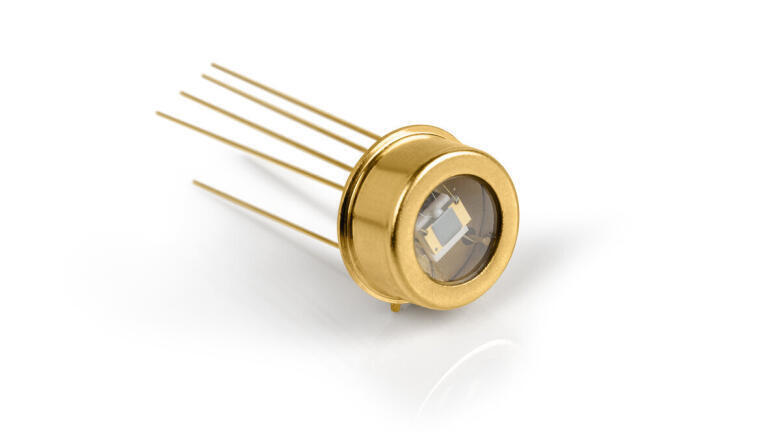
In order to measure gases at particularly small concentrations or very quickly a high sensitivity detector is required, PbSe devices with a responsivity of values of as high as 120k V/W. The devices are manufactured in standard TO style packages and have long expected lifetimes, making them ideal for fit and forget applications such as gas sensing.
Laser Components manufactures a range of innovative lead salt detectors at their factory in Tempe, Arizona. The PB55 is a collection of thermo-electrically cooled polycrystalline biased single element PbSe detectors with a 20% cut off̀ at 5.2 microns and a maximum element size of 6 x 6mm2.
IET Guide 2026

 Product directory