Air sensors
Published over 11 years ago. See the latest and most current information on Air sensors.
Tiny sensors may soon be measuring air quality, according to many specialists in nanotechnology. Ultra-thin and flexible electronics, which can be attached to plants, insects, paper and even our fingernails, could act as sensors, detecting airborne toxins and pollutants.
At Ulsan National Institute of Science and Technology (UNIST), researchers and developers have been working towards manufacturing tiny electronic sensors, which could be mass produced and used to generate detailed data regarding air quality, temperature and humidity. Syncing this environmental data with other available information may even highlight links between environmental conditions and certain illnesses.
Phys.org reports, "The new approach takes advantage of the unique atomic geometries of carbon to synthesize entire arrays of electronic devices, specifically carbon nanotube transistors, carbon nanotube sensors, and graphite electrodes."
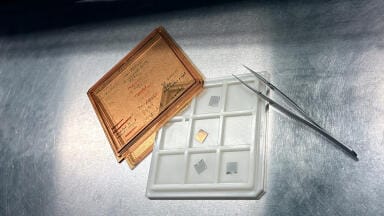
Much like postage stamps, the tiny sensors could be applied to a number of surfaces simply by wetting them first. To date, researchers have successfully attached sensors to stag beetles, newspaper, fingernails and bamboo, as well as a number of other materials. The sensors, which feature integrated antennae, have been used to detect DMM vapour, which is used in sarin gas.
Increasingly, wearable technology is being touted as a viable solution to a number of problems as discussed further in The Future of Air Monitoring and Wearable Technology. Air purification headsets, for example, which filter and monitor the air around us, may soon hit the shops in China and Far East, while researchers in Scotland are currently using rucksacks equipped with monitoring devices to measure air pollution – and its effects – in Edinburgh.
Crucially, these devises harvest and transmit data, enabling us to create a detailed “pollution picture”. In the future, we may be able to access this data via a smartphone and purposefully avoid heavily polluted areas, or even choose to wear a pollution mask or air filter. In addition to this, those in power may seek to alleviate congestion in heavily polluted areas, putting new transport laws in place or incentivising the use of public transport.
Air pollution is a relatively new problem yet its effects are already in evidence. Naturally, the better we understand pollution, the more we can do to counter its effects. Wearable pollution sensors integrate easily into our daily lives and may provide us with invaluable information that could be used to protect human health. In addition to this, understanding the environmental impact of our actions may prompt us to change our behaviour.
If everyone is able to access and understand information regarding the environment, environmental issues may be talked about more widely and taken more seriously by those in power; who knows, tiny sensors may well facilitate big changes in years to come.
IET Guide 2026

 Product directory