Air monitoring
Published over 13 years ago. See the latest and most current information on Air monitoring.
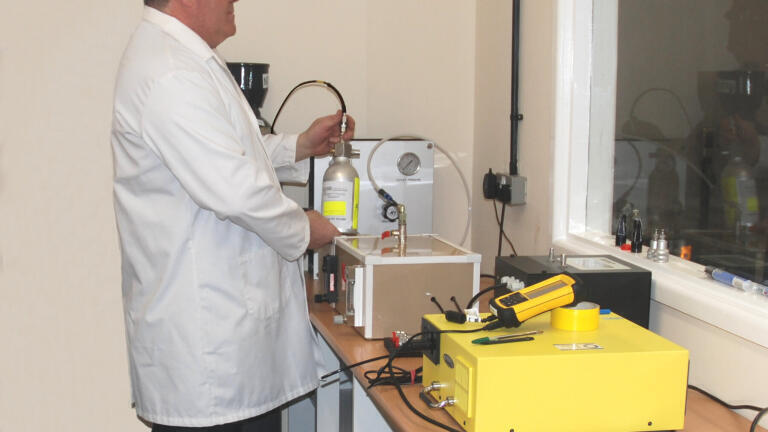
An advanced multiparameter gas analysis technology (FTIR) from Quantitech (UK) is being employed by Case Chemicals to analyse breathing gas for recreational, commercial and military applications. According to Case’s Sam Wray, “This technology provides much higher levels of confidence than traditional techniques, partly because it is highly accurate and also because FTIR can detect almost any gas or vapour.”
The quality of breathing gas is protected by routine analysis of sample bottles taken from the compressors that generate compressed air.
The FTIR analyser employed by Case Chemicals was supplied by Quantitech’s Dr Andrew Hobson who pre-configured the analyser (a Gasmet DX4030) to measure a wide range of parameters including CO, CO2, hydrocarbons, NH3, HCl, HF, NO2, N2O, SO2 and a range of halocarbons such as Freon. This configuration was established to meet and exceed the requirements of both BS EN 12021 and the military standard DEF STAN 68-284.
Commenting on the benefits of FTIR, Sam Wray says, “In the past, some of our clients have used chemical stain tubes which can have an error of up to 30%, so whilst these are individually cheap, they are highly inaccurate in comparison with FTIR. The tubes also only test for an individual parameter, so they are incapable of detecting any contamination other than the parameter on test.”
IET Guide 2026

 Product directory


















.jpg)