Air monitoring
Published over 9 years ago. See the latest and most current information on Air monitoring.
Hundreds of AQMesh pods are currently in use around the world, helping to inform traffic policy, manage building ventilation controls to optimise indoor air quality, detect industrial pollution events, monitor urban pollution hotspots and drive a wide range of research projects.
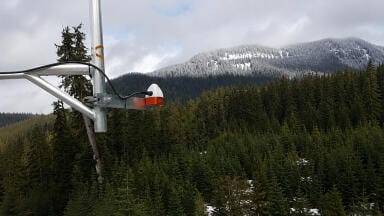
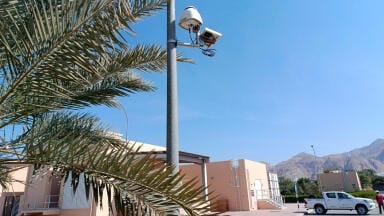
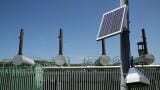
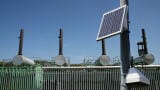
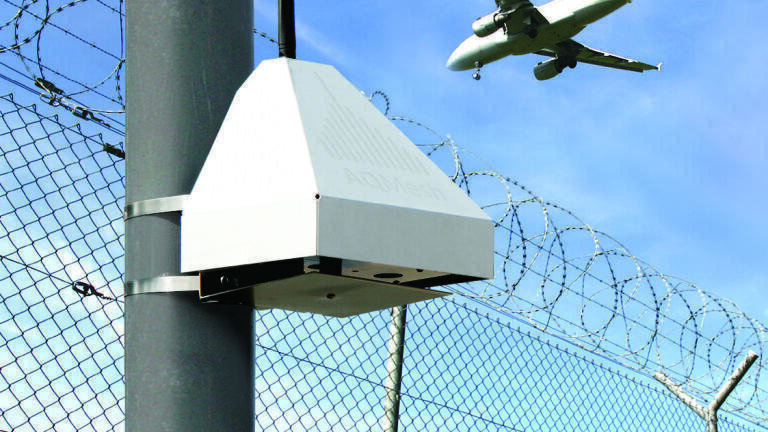
AQMesh offers air quality readings with total flexibility of location for industrial, traffic, urban or other pollution monitoring applications. The small, pole-mounted pods have independent power and communications, and readings are accessed by a secure online login. AQMesh units simultaneously measure five gases – NO, NO2, O3, CO and SO2 – as well as particulates (PM1, PM2.5, PM10 and total particle count) and pod temperature, relative humidity and atmospheric pressure. Gases are measured using electrochemical sensors and particulate matter using an optical particle counter. Communication is via GPRS, so the pod will work anywhere there is a mobile phone signal, and even when the signal is poor, the pod will take measurements, store them until there is a mobile signal and then transmit all stored information.
Installing an AQMesh pod takes only 10 minutes, and readings can be transmitted directly to a public website or display. Alternatively, readings remain entirely confidential, viewed as a table or graph online, downloaded as a CSV file or integrated with the user’s own database by API. A pod can be attached to a post, fence or wall and moved easily, either to compare locations or for use in a series of projects.
This flexibility of location is made possible by the range of power options available. AQMesh can be powered by battery, including lithium and NiMH rechargeable packs, and DC, which can be connected to a local 9-24V source or a neat solar power unit with its own battery.
As part of the growth of the ‘Internet of Things’, many sensors are offered to measure air quality, but users should ask to see a demonstration of accuracy to back up claims – some sensors are simply not sensitive enough and even the best sensors require careful processing of raw output to give the best possible precision and accuracy. Co-located AQMesh pods, however, show excellent agreement with each other and against reference equipment, meaning that this accurate and reliable system can be used to fill the monitoring gaps between reference equipment and diffusion tubes, and to supplement modelling.
A global network of trained distributors can supply AQMesh and provide local support, backed up by a responsive team at the UK manufacturing base, meaning air quality professionals around the world can benefit from AQMesh.
Please click here for more information.
IET Guide 2026

 Product directory

















.jpg)