Water/wastewater
Published over 12 years ago. See the latest and most current information on Water/wastewater.
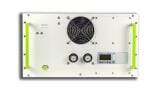
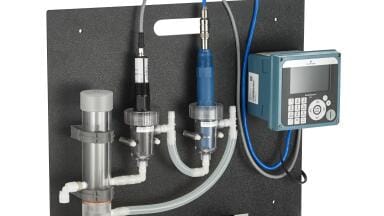
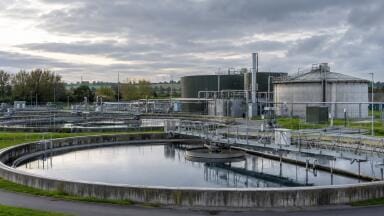
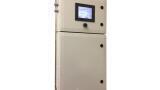
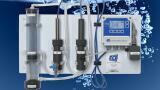
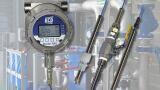
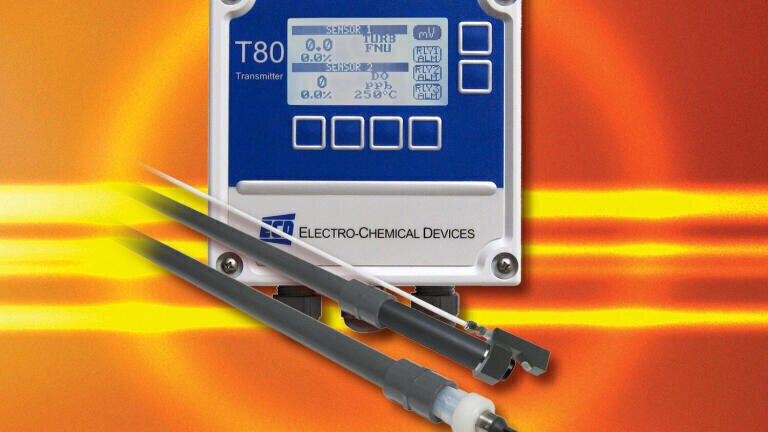
Wastewater treatment technicians who need to measure turbidity and dissolved oxygen (DO) or pH levels in secondary clarifiers will find the dual channel T80 Universal Transmitter and Triton TR6 Turbidity Analyzer from Electro-Chemical Devices, Inc. (ECD) (USA), can be easily combined with the S80 Intelligent Sensors to measure DO, pH or five other common liquid parameters.
The dual channel T80 Transmitter features self-configuring electronics, which provide a fast, easy plug-and-play monitoring solution for waste water treatment. In secondary clarifiers, careful analysis of turbidity, DO, pH and other parameters optimises the treatment process.
The T80 Universal Transmitter eliminates the need to buy multiple transmitters to monitor turbidity, DO, pH, ORP, pION, conductivity or resistivity. With one transmitter processing data from two sensors such as turbidity and DO or pH, the installation requirements are greatly simplified as well as future maintenance.
The Triton TR6 Sensor measures suspended solids or turbidity in four selectable dual ranges featuring pre-set low and high ranges from 0 to 4000 NTU. Its sophisticated optical IR sensor emits a beam of 850 nm (near infrared light) into a water sample where it is scattered by particles suspended in the water. The amount of light reflected back to the sensor by the particles is correlated to the turbidity or suspended solids present.
The flexible Triton TR6 Sensor provides turbidity measurement in milligrams per liter (mg/L), parts per million (ppm) and percent solids of the suspended solids in the water. Turbidity measurements (NTU, FNU) are calibrated to the specific user application environment with standards such as Formazin, StablCal or SDVB beads.
The Triton DO80 Optical Dissolved Oxygen sensor uses fluorescence quenching to determine the oxygen concentration in water. The use of this optical method by the Triton DO80 minimises maintenance, increases reliability and improves the long term accuracy of the measurement.
The S80 Intelligent Sensors pH sensors come in either an insertion/submersion configuration or valve retractable configuration with flared end to prevent blow out. The S80 pH sensor electrodes measure from 0-14 pH. They feature Radel (PES) or PEEK construction materials with single tine, double tine or full crown style pH bulb protection. Spherical bulbs provide the best response, while hemispherical bulbs are more durable and a slightly radiused flat surface is more easily cleaned. They are available in various materials of construction to maximise performance while reducing the cost of ownership.
IET 36.5 Sept/Oct 2026





 Product directory