Water testing
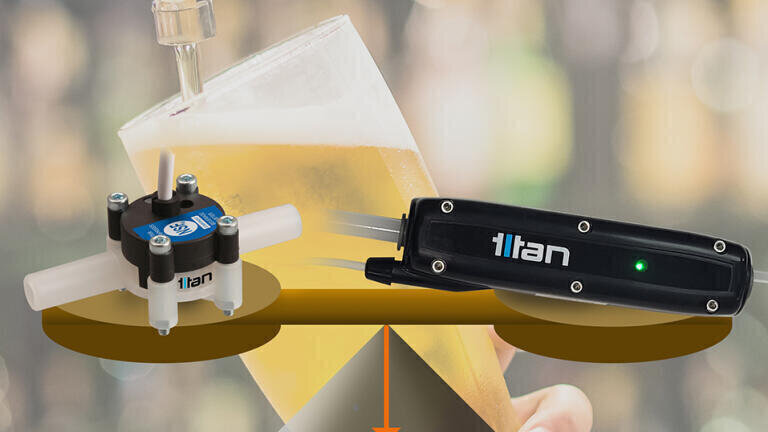
When it comes to beverage dispensing and flow measurement, Titan Enterprises offers two distinct solutions: the well-established Beverage Turbine Meter and the newly released Ultrasonic Beverage Meter. Each has unique strengths and trade-offs, making the choice application-dependent.
Turbine meter operates on a mechanical principle using a Pelton wheel turbine and sapphire bearings. This design provides consistent repeatability and has 1.5% Full Scale Accuracy but introduces moving parts into the system. Constructed from PVDF with sapphire bearings and Viton™ seals, it is robust and resistant to a wide temperature range. This device is NSF-approved under the NSF standard 169 as ‘Special Purpose Food Equipment and Devices’.
Ultrasonic meter uses the ‘time of flight’ principle to measure flow, with no moving parts. This eliminates mechanical wear and contamination risk, while offering a completely clean, straight bore, and accuracy better than 2% of reading. Built from food approved ABS/PC polymer with Viton™ seals, offering a lightweight design with a straight 6 mm bore. The absence of internal obstructions makes it easy to clean using sponge balls. All parts are to FDA / EU food approved standards and NSF-approval will be sought for this product when it reaches full commercialisation.
In terms of granularity, the beverage turbine provides 1400 pulses per litre, resulting in a lower resolution, while the ultrasonic beverage option delivers 5000 pulses per litre for significantly higher resolution.
Regarding flow range, the beverage turbine operates between 0.6 and 10 l/min, with limited low-end capability, while the ultrasonic beverage covers a wider low-end range of 0.2 to 10 l/min, making it more suitable for low-flow applications.
For linearity and repeatability, the beverage turbine offers ±1.0% FSD linearity with excellent repeatability of ±0.1%. The ultrasonic beverage sensor has ±2% of reading linearity and ±0.5% repeatability.
In terms of temperature range, the beverage turbine supports temperatures from 0 to 125°C, making it suitable for both hot and cold beverages. The ultrasonic beverage sensor operates between 3 and 15°C and is therefore primarily limited to chilled beverage applications.
Both beverage meters use John Guest 3/8” push-fit connections, ensuring compatibility with standard tubing. Pressure drop is minimised in both designs; however, the ultrasonic meter’s straight 6 mm bore results in a lower overall pressure drop. Power requirements vary slightly, with the beverage turbine meter operating on 5–24 VDC, while the ultrasonic models require 7–24 VDC. Both meter types are calibrated in situ by the customer to match specific system requirements. Additionally, the ultrasonic beverage meter contains no moving parts, which eliminates contamination risks and allows the use of sponge balls for cleaning.
The Beverage Turbine is budget-friendly and reliable, particularly for high-temperature or mixed-use applications. In contrast the Ultrasonic Beverage is nearly five times the cost, but justifiable for hygienic, low-maintenance, and high-resolution needs.
The Beverage Turbines’ unique selling points are its low-cost, robust, highly repeatable flowmeter, and capable of handling hot beverages. The Ultrasonic Beverage Meter unique selling points are its hygienic design with no moving parts, higher resolution, factory-settable K factor, potential for both NPN and PNP outputs, and easy cleaning. Good linearity enables effective use of the device in variable flow rates.
When considering disadvantages the Beverage Turbine has moving parts within the meter requiring cleaning and can cause blockages if not maintained and the Ultrasonic Beverage has narrow temperature range limits use to cold beverages and a higher upfront cost.
For beverage systems where cost-efficiency, high repeatability, and wide temperature tolerance are priorities, Titan’s Beverage Turbine Meter remains a solid choice. However, in applications demanding hygiene, easy cleaning, low-flow measurement, and long-term reliability with no moving parts, Titan’s new Ultrasonic Beverage Meter justifies its premium price.
The ultrasonic beverage meter is more accurate over the flow range, so ideal for monitoring systems with variable flow. It was also designed to allow cleaning with sponge balls in a beer dispense hose and pipe system.
Ultimately, the decision comes down to whether customers value economy and temperature versatility (Turbine) or hygienic design and precision at low flows (Ultrasonic).
IET Guide 2026

 Product directory























.jpg)