.jpg)
Wastewater analysis
Published over 4 years ago. See the latest and most current information on Wastewater analysis.
Emissions of nitrous oxides (N2O) from the nitrification process, is one of the main climate concerns for wastewater treatment plants given the greenhouse gas warming potential of N2O. And yet, monitoring these emissions is cumbersome and expensive, and comes with a lot of uncertainty.
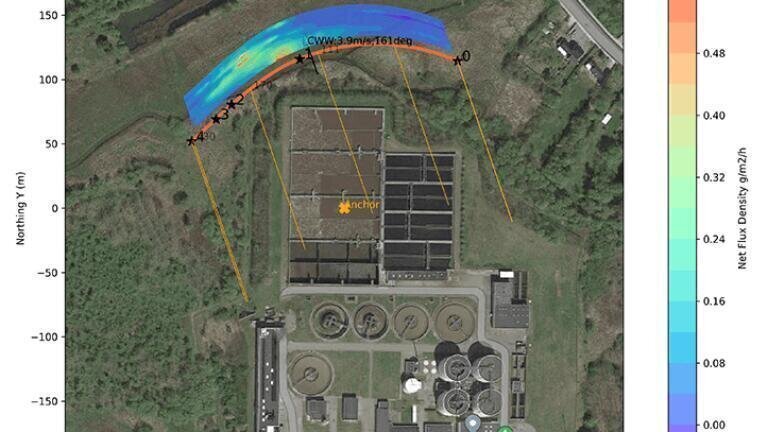
Explicit ApS is changing all that with a new innovative method for measuring and quantifying GHG emissions, including N2O and CO2, from the aeration tanks using ‘sniffer drones’. The method is called DFM – Drone Flux Measurement method.
Focusing on quantifying the total GHG contributions from individual sites, the DFM method uses a drone integrated with high performance gas and wind sensors, in combination with an adaptive flight pattern, to erect vertical flux walls and mapping thousands of data points downwind from the target source. Because both gas and wind data are closely correlated in time and space, Explicit can accurately calculate a net emissions rate (in kg/h) across each wall and provide a consistent representation of the flux density of GHGs emitting from the source.
COO/CMO Bettina Knudsen explains: “The method is very easy to deploy. The flight itself is automated based on pre-programmed waypoints, and the wall design can be adapted to fit the specific site conditions. Each flux wall only takes 15-25 minutes to erect with results averaged over minimum 3 walls. Because we are able to track both gas concentrations and wind simultaneously in great detail, we get a high level of precision in the quantification.”
Capable of measuring N2O concentrations down to ppb levels, the DFM method can measure even small releases and help establish baselines and track reductions.
DFM method is currently being deployed at various WWTPs in Denmark, and Explicit is looking to expand its operations with local partners in the UK, Benelux and beyond. Not limited to N2O and CO2, or to WWTPs, the company is also targeting methane sources such as biogas plants, gas storage facilities, composting sites, landfills, and oil/gas production.
IET Guide 2026

 Product directory