Industrial emissions
Published over 16 years ago. See the latest and most current information on Industrial emissions.
Summary
The recent rise in approvals for the construction of renewable energy plants burning biomass has highlighted the need for specified monitoring equipment to be both cost-effective and flexible. Quantitech Director Dominic Duggan explains: “Whilst biomass power represents an important part of the Government’s strategy to produce energy from renewable sources and to reduce waste to landfill, a debate on the role of such facilities in climate change continues. It is therefore important for monitoring systems to be ’future proof’ – to be able to measure new parameters in subsequent years, such as greenhouse gases.”
Background
Duggan’s views are corroborated by research that was highlighted during the recent COP15 Summit in Copenhagen and revealed that gases such as sulphur hexafluoride (SF6), hydrofluorocarbons (HFCs) and carbon tetrafluoride (CF4) are being underestimated. Whilst these gases are present in only small amounts, they are being given greater consideration because of their considerable greenhouse gas (GHG) capability. For example, SF6 is 23,000 times more potent, weight for weight, than CO2. It is logical to assume therefore, that the monitoring requirements for process emissions such as those from renewable energy plant, will be expanded in the future to cover a wider variety of parameters.
This trend is already taking place in the United States where the Environmental Protection Agency (EPA) has issued the ’Final Mandatory Reporting of Greenhouse Gases Rule’ which requires reporting of GHG emissions from large sources and suppliers. The new rule is intended to collect accurate and timely emissions data to inform future policy decisions.
Under the rule, suppliers of fossil fuels or industrial GHGs, manufacturers of vehicles and engines, and facilities that emit 25,000 metric tons or more per year of GHG emissions are required to submit annual reports to the EPA. The gases covered by the proposed rule are carbon dioxide (CO2), methane (CH4), nitrous oxide (N2O), hydrofluorocarbons (HFC), perfluorocarbons (PFC), sulphur hexafluoride (SF6), and other fluorinated gases including nitrogen trifluoride (NF3) and hydrofluorinated ethers (HFE).
Monitoring equipment specification
The choice of analyser is often dictated by the number of parameters specified in a site’s emissions permit. However, Duggan believes that future monitoring requirements should be taken into consideration, adding, “We have seen a number of biomass projects for which only a small number of parameters have been specified in the emissions permit and this may lead process operators to choose individual analysers for each parameter since that may appear to be the lowest cost option. However, saving small costs in the short term could prove expensive in the medium to long term, particularly since the cost of monitoring equipment is a tiny fraction of the overall budget for a new plant, but would represent a significant item in future operational expenditure."
At present, the requirement for the monitoring of incinerator emissions is most likely to include H2O, CO, NOx, HCl, HF, TOC (Total Organic Carbon), O2, particulates, temperature and flow. Operators therefore have three choices: (1) install individual analysers for each parameter (NDIR, chemiluminescence, etc.), (2) install a multiparameter technology for these parameters (except particulates and flow) or (3) install a multiparameter technology that is able to measure these parameters in addition to any new parameters that may be required in the future.
FTIR is the most commonly employed multi-parameter monitoring technology in the CEMS (Continuous Emission Monitoring System) market. An FTIR spectrometer obtains infrared spectra by first collecting an ‘interferogram’ of a sample signal with an interferometer, which measures all infrared frequencies simultaneously to produce a spectrum. This means that data is collected for the required parameters in addition to spectra for almost all others.
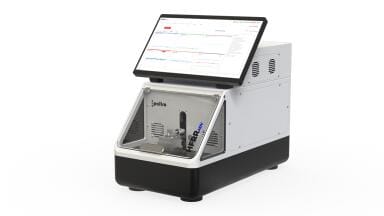
Sample identification is possible because chemical functional groups absorb light at specific frequencies. As a result, gas analysers such as the Gasmet™ FTIR from Quantitech can measure any gas, with the exception of noble (or inert) gases, homonuclear diatomic gases (e.g., N2, Cl2, H2, F2, etc) and H2S (detection limit too high).
Regulatory monitoring requirements
At present, for the purposes of emissions monitoring, wood is not regarded as ’waste’ and as such the incineration of wood is not covered by the Waste Incineration Directive, so the monitoring requirements are less rigorous. Conveniently, therefore, it is possible to install an InSitu FTIR which costs less (about 25% less) than the extractive version, which is supplied with MCERTS certification.
Dominic Duggan believes that a window of opportunity exists to specify InSitu multiparameter FTIR monitoring technology for the incineration of wood. He says, "This option would provide the benefit of a ’future proof’ monitoring system with the capability of adding new parameters without having to buy new instruments. However, it would also represent a lower cost option to extractive FTIR."
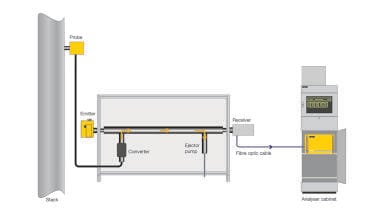
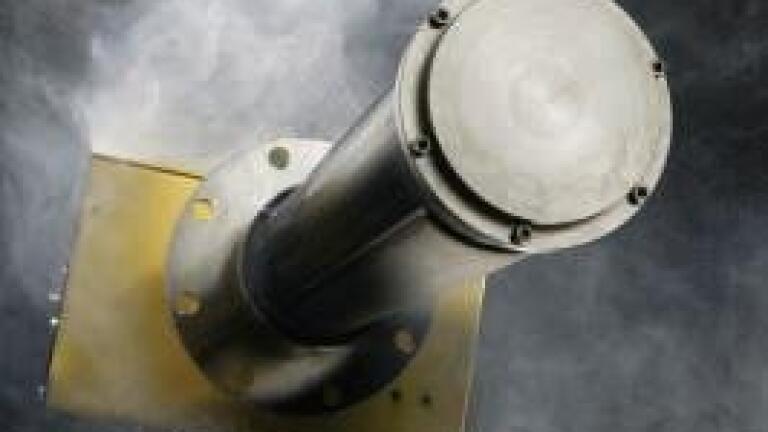
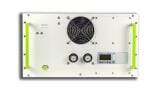
Typically, concentrations of H2O, CO2, CO, NO, NO2, N2O, SO2, HCl, HF, NH3, CH4 are continuously monitored with a single Gasmet™ In-Situ instrument. In addition, different VOC’s can be measured as individual compounds. There is no need for any span calibrations; only zero calibration with instrument air every 24 hours, so operator involvement is minimal.
The Gasmet™ In-Situ has already been employed in biomass and energy from waste plants burning such materials as municipal waste, wood chip, tree bark, peat, coal, heavy fuel oil, short fibre and sludge from paper mills.
Summary
In the UK, most biomass projects are either at the proposal stage or have recently received planning permission. However, the construction phase is often less than two years so Duggan believes that it is important to raise the monitoring issue now, particularly as our political masters debate the ways in which climate change should be addressed.
Summarising his recommendations for the ’future proof’ monitoring of biomass incinerators Duggan says, “Regulators and specifiers should resist the temptation to install the lowest cost options for today’s requirements and take a longer view. The great advantage of FTIR is that the basis of every measurement is a complete spectral analysis of the emission gas so that the instrument is also able to analyse new parameters, such as those that are GHGs, in the future and at no extra cost. Importantly, for those that handle non-waste, an InSitu FTIR could even cost less than a suite of individual instruments.”
IET 36.5 Sept/Oct 2026



 Product directory















.jpg)