Environmental laboratory
Published over 15 years ago. See the latest and most current information on Environmental laboratory.
Non-ferrous metal punching waste materials accumulated during the production of electronic components produces can be recycled. This punching waste is on the one hand garbage, and on the other hand a valuable commodity. This explains the conflict of interest between the releasing company and the recycling partner winning back these valuable metals. The first company wants to achieve the highest price possible for the garbage, whilst the second company wants to earn money by recycling it.
The exact analytical detection of the contents is therefore a prerequisite for both: the commercial evaluation and the direction of the recycling process.
When viewing the task, it quickly becomes clear, that the production of a representative sample is an extreme challenge. The simplest method is the melting down of the corresponding amount of the punching waste. The biggest problem here though, is how to find a suitably sized container for melting down the metals.
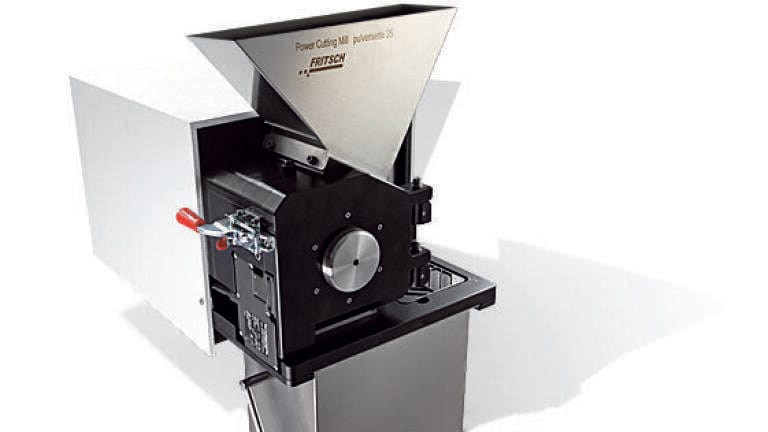
This task is solved with the FRITSCH (Germany) cutting mill PULVERISETTE 25. The punching waste is a hard, abrasive material therefore hard metal tungsten carbide cutting tools are used. Equipped with a 4 mm sieve, a chunky sample is obtained. The acquired material can simply be filled into the melting pot and melted down, allowing for an homogenous sample to be easily taken.
IET 36.5 Sept/Oct 2026


 Product directory