Environmental laboratory
Published over 7 years ago. See the latest and most current information on Environmental laboratory.
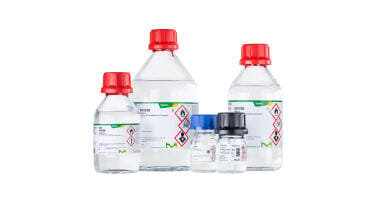
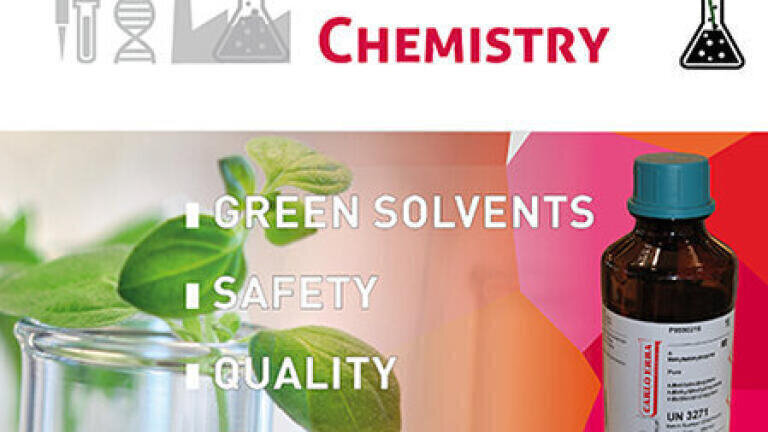
CARLO ERBA Reagents has been an active player in driving the development and adoption of “green chemistry”. They strive to minimise the ecological impact of chemistry by offering a wide array of green solvents.
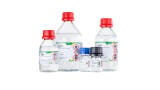
Besides the obvious “green solvents”, water and ethanol, CARLO ERBA Reagents is happy to present a variety of greener alternatives to several commonly used solvents: 2- Methyltetrahydrofuran (2-MeTHF), a green alternative to THF and DCM; 4- Methyltetrahydropyran (MTHP) an innovative alternative to THF; Cyclopenthylmethylether (CPME), an attractive solvent; 1,3-Dioxolane, an environmentally friendly solvent; n,n’- Dimethylpropyleneurea (DMPU), the best “greener” alternative for dipolar aprotic solvents and 1,3-Propanediol, a solvent from renewable source
When substitution of the solvents is not possible, CARLO ERBA Reagents offers its shuttle services, these are stainless steel, returnable containers designed to optimise solvent quality and the management of packaging waste.
For more information on these solvents (chemicals characteristics, physical properties, applications,…) download CARLO ERBA Reagents’ dedicated brochure and check on their website to discover all of their solutions for reducing environmental impact.
IET 36.5 Sept/Oct 2026





 Product directory