Water/wastewater
Published over 14 years ago. See the latest and most current information on Water/wastewater.
Depending on cleanliness requirements, it is possible to achieve clean parts and surfaces with less effort. Regardless of whether the cleaning process is simple or challenging, the efficiency of the process is always important. This includes the relation of input and output, which means the one should minimise usage of resources needed for parts and surface cleaning whilst meeting the required cleanliness. Control variables are, amongst others, the cleaning product or a change of the bath.
Apart from using a cleaning product according to the requirements, adding an accurate quantity of cleaner is very important for the bath’s reconditioning and maintenance. Over- or under-dosage should be avoided as much as possible for cost and quality reasons.
Continuous accumulation of remaining liquids in cleaning and rinsing baths reduces the product quality, so that the baths have to be reconditioned regularly. However, the frequency of bath changes should be efficient. On the one hand, if a bath is changed too early, it will cause an over-consumption for cleaning agents, energy, fresh water and wastewater. On the other hand, if a bath is changed too late, the quality will be reduced.
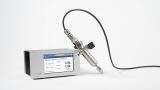
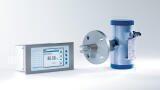
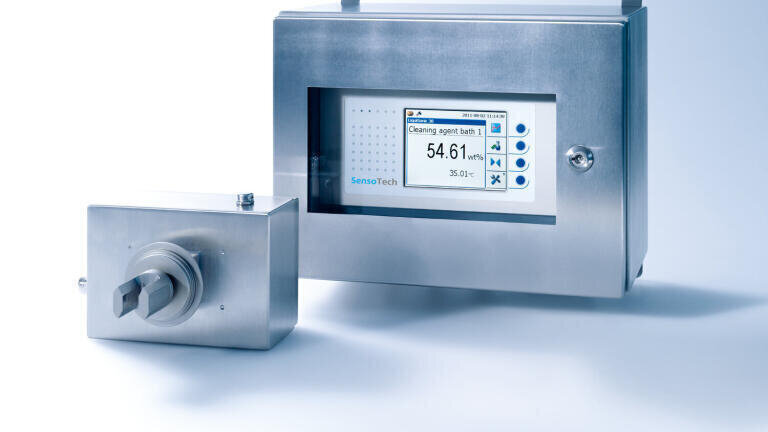
In order to ensure that the cleaning process is reliable and economical, it is recommended to use the “LiquiSonic“ inline analyser manufactured by SensoTech (Germany). The system’s sensor measures the cleaner concentration permanently and directly in the process, so that the values will not fall below or exceed predefined limits. When using the LiquiSonic system, it enables the user to control the change of rinsing baths in a targeted way. Therefore, bath changes passed too early or too late will be excluded.
The concentration measurement is based on the sonic velocity measurement providing fast and precise measured values. The LiquiSonic sensor works maintenance-free and is completely made of stainless steel.
The system’s controller manages and visualises the measuring data. With connection to process control systems, it allows the end user to integrate the process control into the automatic control.
IET 36.3 May

 Product directory