Water/wastewater
Published over 12 years ago. See the latest and most current information on Water/wastewater.
Increasing global awareness of environmental issues has led to a greater interest in monitoring turbidity, one of the most basic ways to assess water quality. ASTM International Committee D19 on Water continues its role as a creator of turbidity standards with the development of ASTM WK4193, Test Method for Determination of Turbidity above 1 TU in the In-Situ Mode. The proposed new standard is under the jurisdiction of Subcommittee D19.07 on Sediments, Geomorphology and Open-Channel Flow.
According to Michael Sadar, vice chairman of D19, ASTM WK4193 will provide practical guidance into the setup, calibration and verification of a turbidity monitoring system before and after it has been placed in the field.
“Many government entities, such as the United States Geological Survey, have intensified their monitoring of turbidity,” says Sadar. “With the increased interest came more questions. For example, if two different technologies are used, why? This is often the case and the intent of the proposed standard is to explain how technologies can be broken down to simplified parts and how each is impacted by turbidity samples and the interference in the samples.”
Sadar adds that the standard will serve as a reminder that when technology is replaced, similar technology needs to be used to obtain comparable results.
“Because turbidity is broad in application, the proposed standard can be applied to any liquid sample that is measured for particulate quality,” says Sadar. In environmental waters, turbidity is used to assess the clarity of water with the general premise that the clearer the water, the higher its quality.”
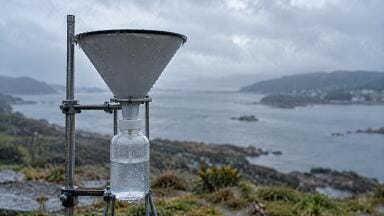
In its most basic applications, ASTM WK4193 will be used to measure the clarity of streams, lakes, ponds and other bodies of water. These measurements will be used to determine if the water body is safe for different uses, including recreation, quantifying erosion or checking if a water filter is working properly.
Those interested in participating in the ongoing development of ASTM WK4193 and other turbidity-related standards are invited to join D19.07.
IET 36.5 Sept/Oct 2026





 Product directory