Industrial emissions
Published over 4 years ago. See the latest and most current information on Industrial emissions.
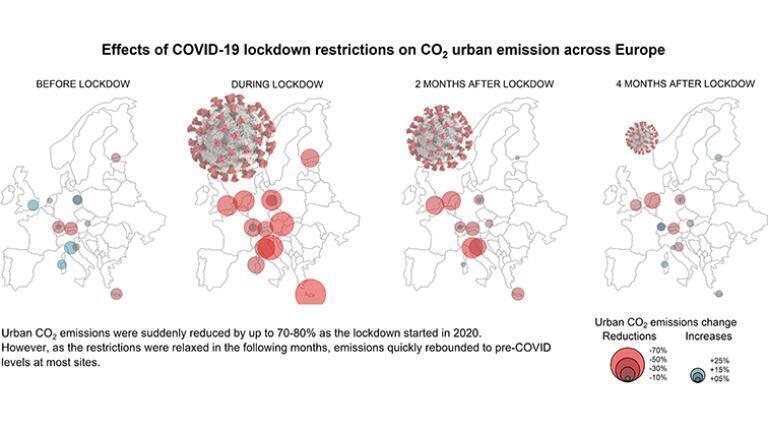
A recent international study led by ICOS scientists highlights the importance of human behaviour in the efforts to cut down CO2 emissions. COVID-19 lockdown measures decreased emissions in European cities up to 87% depending on the area. In four cities, emissions remained surprisingly low even after restrictions were lifted.
As COVID-19 first hit Europe in the spring of 2020, most countries laid out strong restrictions to limit the spread of the virus. Human economic activity and mobility in cities stopped almost instantly, and many people had to move their work from offices to homes.
A recently published study in Science of the Total Environment by Giacomo Nicolini et al shows that daily urban emissions were reduced by 5% to 87% during the lockdown period across 11 cities and 13 measurement sites when compared to the same period in previous years.
The largest reductions were seen in Heraklion in Greece, Pesaro and Florence in Italy, Berlin in Germany, Basel in Switzerland and London in the UK. In London, for example, emissions were reduced by 58%, in Berlin by 63%, in Florence by 66%. In all cases, reductions happened mostly during daytime, except for Vienna, Amsterdam and London, where the restrictions had a clear effect also at night.
“Looking at the diel cycle of CO2 fluxes, the reductions range on average from 67% in the city centre of Heraklion to about 10% in a residential area of Basel,” says Dr. Giacomo Nicolini, the lead author of the paper who was responsible for processing the data at the ICOS Ecosystem Thematic Center.
The study was initiated and led by other scientists from ICOS, the Integrated Carbon Observation System that produces greenhouse gas data in Europe.
Emissions in touristic cities rebounded the slowest
The main reason for the reduced CO2 emissions in all cities was the reduction of vehicular traffic caused by the limitations on mobility. This explains why residential areas saw the quickest rebound of emissions after the restrictions were lifted.
In four cities, Berlin, Pesaro, Amsterdam and London, emissions remained statistically lower even after the restrictions were lifted. In Amsterdam, the lower emissions can be explained by a decreased number of tourists in the observed district. Decreased tourism was likely to have affected Pesaro and London as well.
To effectively mitigate climate change, the researchers conclude, there has to be a bigger systemic change in cities’ ecosystems and in people’s lifestyles. As the COVID-19 lockdown showed, changes in human behaviour have a direct, immediate and significant effect on urban CO2 emissions.
New EU project aims to improve measurements of CO2 in urban areas
The research highlights the importance of measuring urban emissions. To develop best practices in this emerging field, ICOS has taken the task to evaluate different observation methods in its recent EU H2020 project called ICOS Cities.
“The ICOS Cities project will bring an extensive urban greenhouse gas exchange data collection for the global scientific community, available through the ICOS Carbon Portal,” says Professor Dario Papale, University of Tuscia in Italy, and Director of the ICOS Ecosystem Thematic Centre. ”This data collection will be useful for additional analysis on the complex urban greenhouse gas exchange dynamic.”
IET Guide 2026

 Product directory




















.jpg)