Environmental laboratory
Published over 12 years ago. See the latest and most current information on Environmental laboratory.
Aflatoxins were isolated and characterised during the 1960’s after the deaths of over 100,000 turkey poults on farms in Great Britain from what had been referred to as “Turkey X” disease.1,2 Aflatoxins are mycotoxins, structurally related compounds produced as secondary metabolites by Aspergillus molds, primarily flavus and parasiticus. Investigations in Great Britain traced Turkey X disease to mold contaminated peanut meal imported from Brazil. Although more than a dozen aflatoxins exist, the four major toxins of interest are B1, B2, G1 and G2. They are designated according to their fluorescent properties. Aflatoxin B1 and B2 emit in blue wavelengths, while G1 and G2 emit in yellow-green wavelengths. Aflatoxins have been shown to be toxic in animals and humans.
The target organ is the liver (aflatoxins are hepatocarcinogens). Once produced, aflatoxins are relatively stable compounds in a broad range of environments. They may persist as contaminants in grains, feeds and nuts, regardless of processing or cooking. Of particular interest is aflatoxin B1, the single aflatoxin listed by the International Agency for Research on Cancer (IARC) as a Group 1 carcinogen. Because of these findings, and because aflatoxins are ubiquitous in important agricultural commodities including maize and peanuts (ground nuts), they are some of the most intensely studied mycotoxins.
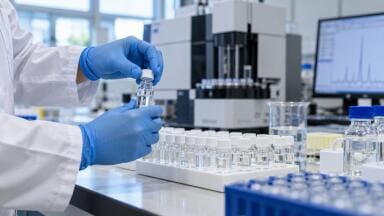
International regulatory agencies have set contamination levels for aflatoxins in animal feedstuffs. Since Aspergillus may infect commodities pre-harvest, during storage or during processing, monitoring for aflatoxins in associated agricultural commodities at all stages of production is requisite.Field screening methods exist that are adequate to estimate contamination levels for aflatoxins. When additional confirmation or quantification is desired, chromatographic laboratory analysis is often necessary.Preparation of matrix samples prior to chromatographic analysis typically requires extraction and purification. Commonly, immunoaffinity columns (IAC), which employ a multi-step bind and elute mechanism to concentrate and purify aflatoxins, are used to purify matrix samples for subsequent analysis. Solid phase extraction (SPE), an alternate method which may use interference removal, can also be employed.
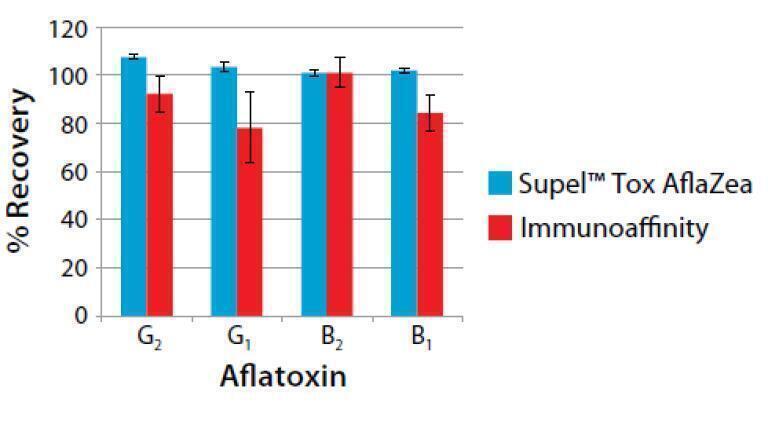
Tests have illustrated that sample preparation using Supel Tox AflaZea SPE, from Supelco (USA) cartridges for cleanup is faster and simpler compared to the IAC cleanup method. Because fewer steps are needed to accomplish the SPE method, less variability is introduced into sample preparation, giving a more reproducible method. Also, the time associated with sample prep using SPE was far less than that associated with IAC, allowing for an ultimate increase in sample throughput. In addition, labware, reagents, and necessary equipment to perform sample preparation are minimal when using SPE. Supel Tox AflaZea SPE cartridges demonstrate superiority over IAC columns in terms of process simplicity, time required for sample preparation, and control of variation while maintaining the same sample cleanup performance associated with IAC purification.
IET 36.5 Sept/Oct 2026




 Product directory