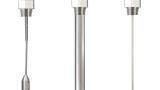
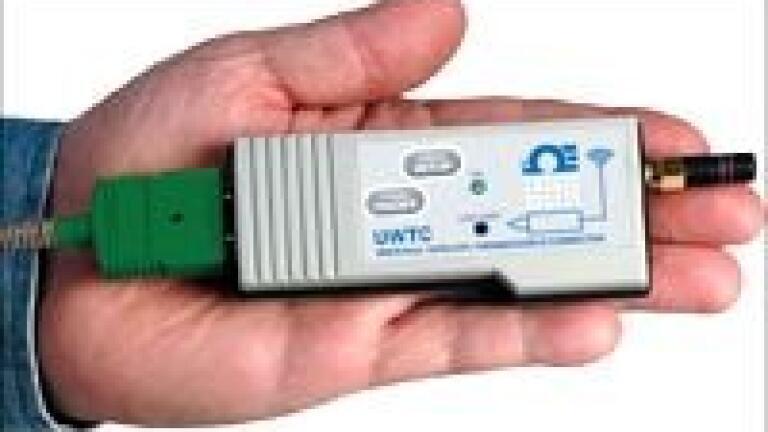
Omega’s (UK) new Wireless Thermocouple Connector Series features stand-alone, compact, battery powered thermocouple connectors that transmit their readings back to a host receiver up to 90 m (300') away.
Each unit can be programmed in the field to work as a type J, K, T, E, R, S, B, N or C calibration connector. When activated the connector will transmit readings continuously at pre set time interval that was
programmed by the user during the initial setup.
Each unit measures and transmits: Thermocouple Input Reading, Connector Ambient Temperature, RF Signal Strength and Battery Condition to the host and is displayed on the PC screen in real time using the provided software. When used with host receiver model UWTC-REC1, data from up to 12 wireless thermocouple connectors can be received and displayed. Each unit includes free software that converts your PC into a strip chart recorder or data logger so readings can be saved and later printed or exported to a spread sheet file.
When used with host Transceiver model UWTC-REC2 wireless data from one connector can be re-transmitted out of the receiver by a wired connection as an analogue voltage, current or thermocouple signal to
interface with a controller, PLC or data acquisition board.



 Product directory