.jpg)
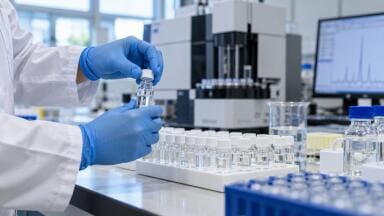
Environmental laboratory
Five years on, and more than a year into a new government, the opposite appears to be happening.
An analysis by the Institute for European Environmental Policy (IEEP) and The Guardian finds that the UK has failed to adopt 28 new or revised EU environmental laws, while actively weakening four areas of inherited protection.
For those working in monitoring and compliance, the divergence raises urgent questions.
Which standards should apply, who enforces them and what happens when the data is troubling but still compliant under weakened regulation?
Water quality has become the clearest example of divergence.
The EU’s 2024 urban wastewater treatment directive obliges member states to tighten effluent standards, introduce advanced treatment to strip out pharmaceuticals and microplastics, and make polluters pay. England remains far behind.
The OEP has found the country will miss its legal target to bring 77% of surface waters into good ecological status by 2027, with the real figure likely closer to 21%.
For instrumentation users, this is stark.
While EU plants are being retooled for micropollutant monitoring, UK utilities are not under the same obligation, raising the risk that rivers become a sink for substances elsewhere phased out.
Air quality standards are also slipping.
The EU’s new ambient air quality directive sets much stricter thresholds for fine particulates and nitrogen oxides, in line with WHO advice.
The UK has chosen not to follow, instead freezing air quality rules at their Brexit baseline.
The EU has also upgraded its industrial emissions, fluorinated gases and ozone-depleting substances regimes, while the UK has not.
Monitoring networks face a mismatch: instruments will continue to flag breaches of WHO health thresholds, but without matching UK law, enforcement is blunt.
The UK’s record on decarbonisation is often praised, largely due to the phase-out of coal in electricity generation.
But the EU is pressing forward in harder-to-treat sectors with binding targets on energy efficiency as well as the Secretary of State for Energy Security and Net Zero’s mandate to expand renewable generation.
Most strikingly, the EU’s 2024 methane regulation compels the fossil fuel sector to monitor emissions across oil, gas and coal, and progressively requires the same of imports.
The UK has not adopted this regime, leaving a major gap in climate accountability and in demand for continuous methane detection systems.
Perhaps the sharpest divergence is in chemicals.
Since Brexit, the EU has banned 13 hazardous substances, including PFAS in foams, lead gunshot in wetlands and intentionally-added microplastics, while the UK has banned none.
The EU has added 41 substances to its watchlist for potential future bans; the UK has added zero.
The reason for this lies in resources: the UK’s replica of the EU’s REACH system is underfunded, slow and struggling to process dossiers.
For monitoring professionals, this produces a confusing split: laboratories testing to EU standards may report substances as restricted, while in the UK market they remain legal.
The EU has moved faster to ban harmful pesticides and tighten residue limits.
The UK only ended the emergency use of bee-killing neonicotinoids this year, four years later than the EU.
Meanwhile, uncertainty in farming subsidy schemes is undermining incentives for farmers to invest in long-term monitoring and habitat restoration.
Whereas the EU’s Common Agricultural Policy operates in seven-year cycles, UK budgets are subject to surprise annual cuts, eroding both trust and continuity.
For environmental monitoring professionals, the message is clear.
Instruments can measure water pollutants, track species loss, detect methane and log particulates with ever-greater precision.
But without robust regulatory baselines and enforcement powers, that data is unlikely to result in much action.
The divergence is not inevitable.
As Michael Nicholson of the IEEP notes, “The EU is no nirvana, but the UK is losing the race to the top.”
The choice remains open: Britain could use its autonomy to exceed EU standards, creating new opportunities for innovation in monitoring and compliance.
Instead, for now, it risks becoming the weak link in Europe’s environmental chain.
IET Guide 2026

 Product directory