Air monitoring
Europe’s air quality monitoring is undergoing its most profound shift in a generation.
Despite decades of regulation, air pollution remains the continent’s leading environmental health threat, still linked to an estimated 300,000 premature deaths annually.
A revised EU Ambient Air Quality Directive, adopted at the end of 2024, now sets tougher limits for 2030: the fine particulate (PM₂.₅) threshold will be halved, nitrogen dioxide (NO₂) and other pollutants will face tighter caps, and monitoring standards will be raised.
The message is clear. By the end of the decade, much of Europe’s compliant air quality will no longer be considered acceptable.
For environmental monitoring professionals, that means new instruments, new pollutants, new data sources, and a heavier burden of accountability.
The most striking change in 2025 is the expansion of what counts as air pollution worth tracking.
For the first time, EU law requires monitoring of ultrafine particles (UFPs) – those microscopic fragments under 0.1 μm in diameter that slip into the bloodstream and may affect not only lungs and hearts but also neurological health.
These have long been suspected of outsized impacts but have never been part of compliance networks.
Now, countries must roll out condensation particle counters and mobility sizers to measure particle numbers and size distributions, fundamentally altering network design.
Alongside UFPs, other previously neglected pollutants are moving up the agenda.
Firstly, there's black carbon – the sooty particulate from diesel engines and biomass burning, with both health and climate impacts. Expect more aethalometers in roadside and residential monitoring sites.
Released mainly from farming, ammonia (NH₃) fuels the formation of secondary PM₂.₅. Rural monitoring networks are being strengthened to capture its role in regional haze events.
Beyond benzene, dozens of VOCs influence ozone chemistry, demanding more sophisticated measurement.
Lastly, there's oxidative potential of PM, which is still experimental, but its mention in EU policy suggests regulators are beginning to think about not just how much particulate matter is in the air, but how chemically reactive – and damaging – it may be.
This list reflects a recognition that traditional pollutants – PM₁₀, PM₂.₅, NO₂ – no longer capture the full story of Europe’s air pollution burden.
What isn’t measured isn’t managed, and 2025 marks a deliberate attempt to close those gaps.
How this new monitoring challenge is met will depend heavily on technology. The backbone of compliance remains ground-based reference stations, but the landscape is rapidly diversifying.
One of the year’s headline developments is the upcoming launch of Copernicus Sentinel-4, Europe’s first geostationary air quality satellite.
From its perch over Europe, Sentinel-4 will deliver hourly maps of NO₂, ozone, sulphur dioxide and formaldehyde – a huge upgrade from once-daily polar-orbiting snapshots.
That means being able to track rush-hour pollution peaks, industrial plumes, wildfire smoke and even Sahara dust clouds in near real time.
By feeding into the Copernicus Atmosphere Monitoring Service, the satellite promises sharper forecasts and better hotspot detection, complementing national networks.
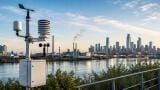
On the ground, sensor innovation is accelerating. Low-cost monitors are spreading across cities and rural areas, producing street-level pollution maps once unimaginable.
Projects like CurieuzeNeuzen in Belgium or Measure Together in the Netherlands show how citizen deployments can fill data gaps and influence policy. For professionals, the challenge is calibration, validation and integration: distinguishing signal from noise in a flood of cheap sensor data.
Here, AI is stepping in.
The European Centre for Medium-Range Weather Forecasts has begun running AI-based forecasting models alongside traditional physics-based systems. These models consume far less energy and can generate multiple pollution scenarios quickly – from the impact of closing coal plants early to the effects of mass vehicle electrification. AI is also being used to correct sensor drifts, stitch together satellite and ground observations, and generate hyper-local forecasts. The result is a more dynamic, data-rich monitoring environment – but one that demands new expertise from professionals used to working with simpler networks.
If the new pollutants and technologies feel demanding, the legal and political context adds further weight. Under the revised directive, citizens gain the right to seek compensation for health damage if authorities fail to meet the standards. That means monitoring data could end up in court, scrutinised for accuracy and traceability. Every calibration, every instrument fault log, every data flag could be contested evidence.
At the same time, public expectations are shifting. Citizen science projects have shown the power of grassroots monitoring, sometimes revealing pollution hotspots missed by official stations. While EU law still excludes citizen data from compliance, local agencies are beginning to use it for planning and public engagement. The momentum is clear: the public is no longer a passive consumer of air quality information but an active participant. Professionals who treat citizen groups as partners rather than adversaries may find their monitoring efforts amplified and legitimised.
Complicating everything is climate change. Wildfires, once rare in northern Europe, are now regular spring and summer events, contributing to particle spikes in the UK, Germany and Scandinavia. Dust intrusions from the Sahara are more common, and even Canadian wildfire smoke crossed the Atlantic in 2025 to affect Ireland and Scandinavia. Traditional seasonal pollution patterns are less predictable; monitoring networks must be agile enough to track these new, transboundary threats.
Meanwhile, the health burden remains severe. Even under today’s limits, 94% of Europe’s urban population is exposed to PM₂.₅ above WHO guidance. Air pollution silently drives chronic disease, healthcare costs and lost productivity. Public campaigns calling for clean air now attract tens of millions of signatures. For policymakers, the message is urgent: cleaner air isn’t just environmental policy, it’s public health necessity.
So what does this all mean for Europe’s environmental monitoring community?
It means we will need to begin assessing whether existing networks can detect pollutants at the lower 2030 limits, and prepare for new requirements like ultrafine particle and ammonia monitoring.
Then, we'll need to develop capacity to merge satellite, ground, sensor and AI-driven datasets into coherent analyses. This will be the new normal.
Expect greater scrutiny of data quality. Documentation, QA/QC, and traceability will be critical safeguards.
Work more closely with health agencies, climate modellers, city planners and citizen groups. Monitoring is no longer just a technical exercise; it’s part of a broader social and political fabric.
Stay alert to the next wave – whether that’s airborne microplastics, new industrial chemicals, or metrics like oxidative potential. The profession is shifting from compliance to anticipation.
2025 is not business as usual.
The air that seems acceptable today will be deemed unsafe tomorrow, and the instruments, models and institutions of Europe’s monitoring networks must adapt.
For professionals, this is both daunting and exhilarating.
We stand at the forefront of a new era: one where every measurement carries more weight, every dataset is more complex, and every decision is more urgent.
If Europe succeeds, millions will breathe cleaner, healthier air by 2030.
But success will depend on how effectively the monitoring community seizes this moment – upgrading tools, embracing innovation, engaging with the public, and holding institutions accountable.
IET 36.3 May


 Product directory








.jpg)