Mass spectrometry & spectroscopy
The market for dealcoholised and alcohol-free wines is growing due to changing consumer preferences, moderation trends, and demand for premium low- and no-alcohol alternatives. This product category, however, presents a distinct analytical challenge for producers. Although marketed as ‘alcohol-free’ or ‘non-alcoholic’, these products typically contain small amounts of residual ethanol, which plays an important role in aroma transport, flavour perception, and mouthfeel. As a result, producers must reduce alcohol content as close as possible to legal thresholds without compromising sensory quality [1].
In many markets, regulatory thresholds for non-alcoholic labelling are below 0.5% v/v, which conventional alcohol determination methods used for standard wines are often not sufficiently sensitive or suitable to measure [2]. Reliable residual alcohol measurement is therefore essential for legal compliance and labelling accuracy, as well as process control, release testing, and quality assurance throughout production.
Dealcoholised wines are typically produced either by first creating a conventional wine and then removing ethanol, or by formulating beverages based on grape must, juice, and flavour components. Common dealcoholisation processes include vacuum distillation, membrane separation, and spinning-cone column treatment.
While these technologies remove ethanol, non-volatile components such as glycerol remain largely unchanged. As matrix components can influence low-level alcohol measurement, this must be considered when optimising analytical models for dealcoholised wine.
This article presents a technical overview of wine dealcoholisation from an analytical perspective and describes an approach for precise determination of residual ethanol in dealcoholised wines using an improved wine model for NIR-based alcohol measurement. The results show that optimised measurement models can significantly improve agreement with GC-FID reference analysis, supporting reliable control of dealcoholised wine products across different wine styles.
Accurate quantification of ethanol at trace levels requires an analytical method with high sensitivity, selectivity, and repeatability. Gas chromatography (GC) remains one of the reference techniques for this task because it can measure very low alcohol concentrations and distinguish ethanol from other volatile compounds. However, GC is relatively expensive, time-consuming, and dependent on skilled laboratory personnel, making it less practical for fast routine quality control in many production environments [3].
Other established wine analysis methods also show limitations when applied to dealcoholised wine. Distillation followed by density measurement is not ideal because the ethanol concentration is extremely low. Enzymatic methods, while useful in some beverage categories, have not consistently proven robust for alcohol-free wine matrices. This makes rapid spectroscopic methods particularly attractive, provided that the analytical model is tailored to the specific matrix effects of dealcoholised wine.
Near-infrared spectroscopy (NIR) offers a practical alternative for routine alcohol analysis. Fast, selective, and suitable for high-throughput beverage testing, NIR-based alcohol determination is already well established in standard wine analysis. For dealcoholised wines, however, the challenge lies in extending the model’s performance below 0.5% v/v while maintaining accuracy across white, rosé, red, and sparkling matrices. The improved wine model discussed here was developed specifically to address this gap and enable reliable ethanol measurement in the low-alcohol range relevant for labelling and compliance.
Samples were taken from sealed bottles and degassed where necessary. This step is particularly important for sparkling wines and also necessary for white wines, which can contain significant amounts of dissolved CO2. For degassing, approximately 300 mL of sample was transferred into an Erlenmeyer flask and shaken to release carbon dioxide. The prepared samples were then transferred into 50 mL vials and sealed for analysis with the alcohol measurement system. For GC-MS, 10 mL of degassed sample were mixed with 0.05 mL 1-propanol as an internal standard and transferred into sealed headspace vials.
Proper degassing is a critical step because residual CO2 falsifies both density and alcohol measurements. For dealcoholised sparkling wines and lightly carbonated white wines, especially, dissolved gas can distort low-level ethanol results if not adequately removed before analysis.
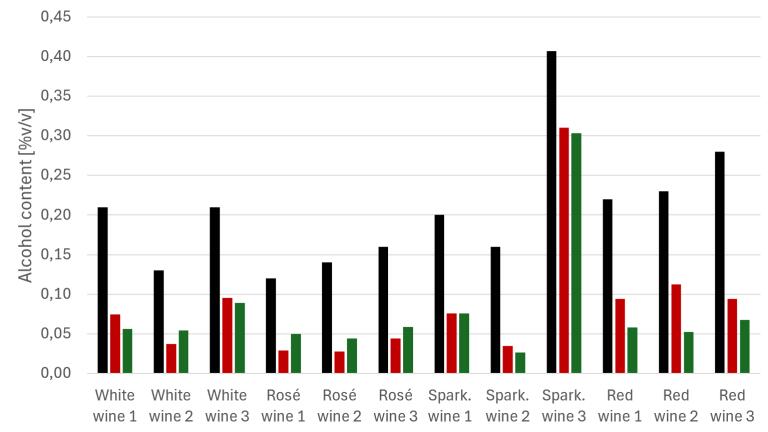
The data shown in Figure 1 indicate that the improved wine model yields markedly better agreement with GC-MS than the previous model. This improvement was consistent across all tested wine categories: sparkling wine, white wine, rosé wine, and red wine.
The data displayed are representative for 13 tested samples of each type (white, red, rosé, and sparkling).
Dealcoholised wine products are analytically demanding, and small absolute errors can have major implications when a product is positioned close to a regulatory threshold. In practical terms, improving the deviation from up to 0.2% v/v to up to 0.1% v/v substantially increases confidence in production decisions, product release, and label claims.
Due to spectral interference, extract content can have a minor influence on the deviation between NIR-based alcohol measurement and GC reference data. In Figure 2, comparisons between the old wine model, the new wine model, and GC show that the optimised model tracks the reference values more closely across the sample set, particularly in the critical range below 0.5% v/v. A matrix dependency of the NIR signal caused by extract (mostly sugars, acids, and glycerol) was successfully compensated to reduce deviations to ≤ 0.07% v/v for all tested samples.
This finding illustrates a central analytical challenge in dealcoholised wine: the residual matrix becomes proportionally more important as ethanol decreases. Components such as sugars, acids, polyphenols, and glycerol contribute relatively more strongly to the overall matrix signal, meaning that a model developed for conventional wines cannot simply be extrapolated into the trace-alcohol range without adjustment. The improved model therefore represents not just a calibration update, but a matrix-specific optimisation for low-alcohol wine analysis.
One of the most significant matrix components is glycerol, which is naturally formed during fermentation by wine yeast and is typically present at concentrations of about 5 g/L to 15 g/L in finished wine. The glycerol content is generally higher in wines with higher sugar content, with red wines typically containing a larger amount of it. Because it is non-volatile, dealcoholisation processes remove ethanol while leaving glycerol largely unchanged.
From a sensory standpoint, glycerol is beneficial because it contributes sweetness, viscosity, and mouthfeel, helping compensate for the structural role of ethanol in wine. Analytically, however, glycerol can influence alcohol determination and must therefore be considered when evaluating measurement accuracy.
Eight wine samples were examined in detail for this effect using GC, a non-pressurised alcohol measurement system, and an enzymatic glycerol test. The results showed that increasing glycerol concentration led to increasing deviation between the NIR alcohol meter and GC when using the older wine model. Figure 1demonstrates that this deviation trend is substantially improved with the new model, and that correction of the glycerol effect improves agreement between the rapid method and the GC reference.
The expected alcohol accuracy as a function of glycerol concentration is displayed in Figure 3. For wines with lower glycerol content, the agreement with GC is best. As glycerol rises, somewhat larger deviations must be expected, although still within a practically useful range. Comparability reaches better than ± 0.15% v/v depending on glycerol content. This is a key insight for laboratories and producers, because it connects analytical performance directly to product matrix composition and helps define realistic expectations for different dealcoholised wine styles. For wines with 3-7 g/L glycerol, alcohol accuracy is better than 0.05% v/v; for 0-3 g/L and 7-10 g/L glycerol, it is better than 0.10% v/v. For wines with 10-15 g/L glycerol, alcohol accuracy is better than 0.15% v/v. The green data show additional compensation based on the glycerol content if it is known. This reduces the deviation to reference measurement to below 0.03% v/v for all tested samples.
For producers of dealcoholised wine, residual alcohol measurement is not a purely regulatory exercise. It is closely tied to process optimisation, sensory balance, and product consistency. Since ethanol contributes to aroma release and mouthfeel, producers often want to retain as much as legally permissible. That strategy only works when residual alcohol can be measured accurately and repeatedly near the legal threshold. Otherwise, there is a risk of exceeding labelling limits or over-processing the wine and unnecessarily compromising flavour.
A rapid NIR-based system with an optimised model offers several practical benefits in this context. It reduces analytical turnaround time compared with GC-MS, supports routine in-house QC, and allows producers to check multiple product types using one workflow. When properly validated against the reference method, it can be used to monitor dealcoholisation performance, verify finished product compliance, and support stable production quality across different wine matrices.
The importance of sample handling should also not be underestimated. As shown in the method description, degassing is essential wherever CO2 is present. Without this step, the analytical precision of even a well-optimised system can be compromised.
For sparkling and semi-sparkling dealcoholised wines in particular, robust sample preparation remains a prerequisite for reliable results.
Dealcoholised wine is a fast-growing category that demands highly reliable control of residual alcohol at very low concentrations. Because these products often operate close to legal labelling thresholds, analytical methods must provide excellent sensitivity, repeatability, and matrix-specific robustness. Standard methods used for conventional wine are not always sufficient in this range, especially when extract and glycerol effects become more pronounced.
The results summarised here show that an optimised NIR-based wine model can significantly improve the accuracy of residual alcohol determination in dealcoholised wines. Compared with GC reference analysis, the improved model reduced deviations from up to 0.2% v/v to up to 0.1% v/v across sparkling, white, rosé, and red wines, while achieving repeatability of ≤ 0.01% v/v. The model also better compensates for matrix effects associated with extract and glycerol, making it suitable for a broad range of dealcoholised wine products.
For wine producers, this enables faster and more reliable routine control of dealcoholised products, ensuring regulatory compliance, accurate labelling, and consistent sensory quality. In a market where product quality and legal conformity are equally important, accurate low-level ethanol determination is a key enabler of successful wine dealcoholisation.
1. 1. Non-alcoholic wine market growth and projections
Grand View Research. (2025). Non-alcoholic wine market size and share report, 2024–2030. https://www.grandviewresearch.com/industry-analysis/non-alcoholic-wine-market-report
2. Regulatory threshold for “non-alcoholic” products
U.S. Government Publishing Office. (2025). Title 27 Code of Federal Regulations § 7.65 – Alcohol content (Definitions). https://www.ecfr.gov/current/title-27/chapter-I/subchapter-A/part-7/subpart-E/section-7.65
3. OIV. (2021). Compendium of international methods of wine and must analysis (Vol. 1). International Organisation of Vine and Wine.
IET 36.2 Mar/Apr 2026



 Product directory









.jpg)



.jpg)
.jpg)